about the breed
BUYER BEWARE — THE AUSTRALIAN LABRADOODLE IMITATION GAME
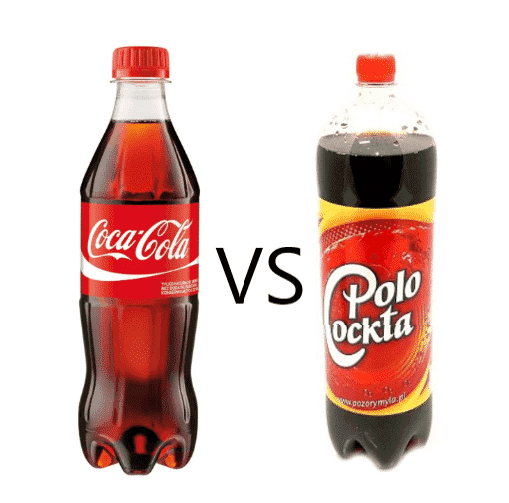
Almost the same? Almost can make all the difference — as a certain advertisement once reminded us.
Here I would like to explain, once and for all, the difference between a Labradoodle and a multigenerational Australian Labradoodle. I know it is not as clear-cut as it may seem. I was once in your position, and understanding the difference took me some time.
The facts:
The Australian Labradoodle was developed in Australia. Although the first Labrador–Poodle mating was not actually initiated by Wally Conron as often claimed, let us use that account for the moment. He paired a Labrador with a Poodle to obtain particular qualities and meet a specific need.
The famous Sultan was born, the only puppy in his litter with the desired qualities: he did not trigger allergies and had the right potential to work with a blind person. The only one? Not a spectacular result, given that there were just three puppies. A 33.33333% success rate is hardly a moon landing. Yet today some people consider that enough to charge EUR 1,500–2,000 for a puppy, even if your own beloved companion falls into the other 66.66666% and, a year later, sheds profusely, makes you sneeze, has a temperament you cannot manage, and also needs a EUR 5,000 hip replacement.
How is your breeder supposed to know what your puppy will become? There is the convenient explanation — surely they are innocent! You might be lucky, or you might not. Then perhaps you complain, or eventually surrender the dog to a shelter when you can no longer breathe comfortably. Or the dog somehow gets lost, and despite having an unregistered microchip, you do not acknowledge the dog in Facebook notices. Too harsh? These things really happen. This is the world facing those poor hybrids produced hastily for quick profit.
REMEMBER!
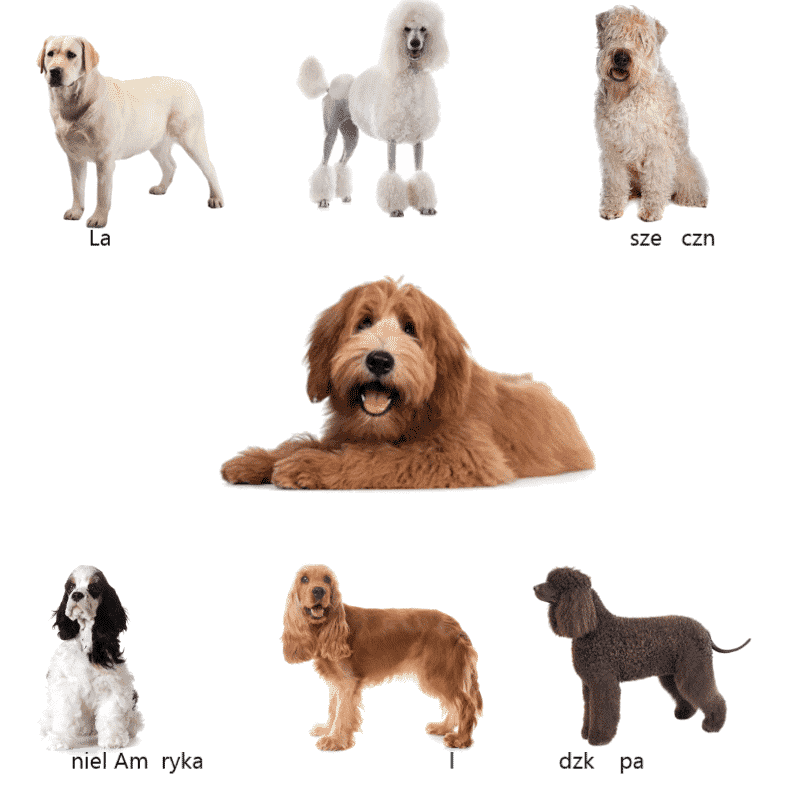
According to the breed's founder, Beverley Manners, the ancestors of a genuine multigenerational Australian Labradoodle are:
Labrador Retriever Poodle Wheaten Terrier Irish Water Spaniel English Cocker Spaniel American Cocker Spaniel
Yes, all those breeds. Beverley, who ran Rutland Manor Research Center, introduced each for a SPECIFIC PURPOSE.
Some organizations do not accept the Wheaten Terrier infusion but recognize the Curly-Coated Retriever instead. ALFA-Europe followed the founder's approach. None of this changes one important fact: Australian Labradoodles do not descend from just two breeds, Labrador and Poodle.
WHAT IS AN AUSTRALIAN LABRADOODLE?
WHAT IS NOT AN AUSTRALIAN LABRADOODLE?
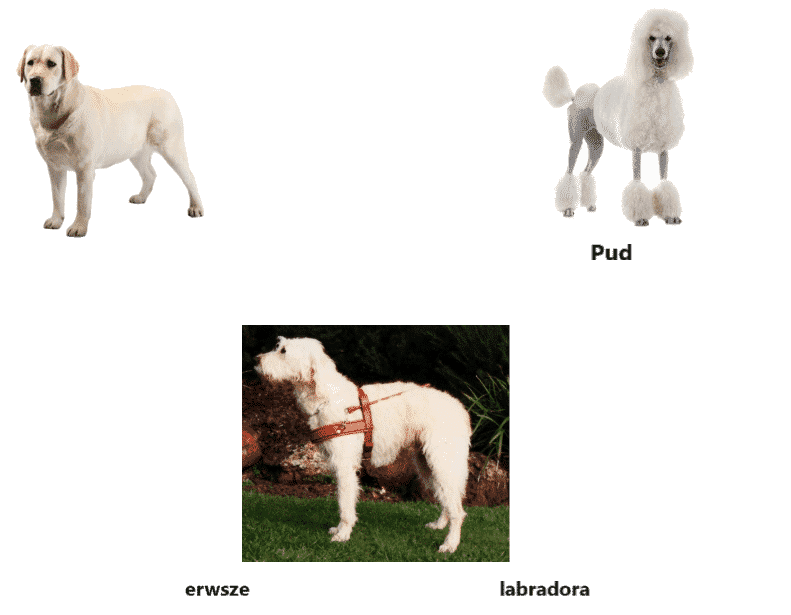
WHAT STILL IS NOT AN AUSTRALIAN LABRADOODLE?
| CROSSES | GENERATIONS |
|---|---|
| LABRADOR + POODLE | F1 (FIRST GENERATION) |
| F1 + POODLE | F1B |
| F1B + POODLE | F1BB |
| F1 + F1 | F2 (NOT A RECOMMENDED PAIRING) |
| F1B + F1 | F2 |
| F1B + F1B | F2 |
| F1 + F1BB | F2 |
| F1BB + F1BB | F2 |
| F1 + F2 | F2 |
| F1 + F3 | F2 |
| F1 + MULTIGEN | F2 |
| F1B + F2 | F2 |
| F1B + F3 | F2 |
| F1B + MULTIGEN | F2 |
| F1BB + F2 | F2 |
| F1BB + F3 | F2 |
| F1BB + MULTIGEN | F2 |
| F2 + POODLE | F2B |
| F2 + F2 | F3 |
| F2 + F3 | F3 |
| F2 + MULTIGEN | F3 |
| F2B + F2 | F3 |
| F2B + F2B | F3 |
| F2B + F3 | F3 |
| F2B + MULTIGEN | F3 |
| F2B + F2B | F3 |
| F3 + F3 | MULTIGEN |
| F3 + POODLE | F3B |
| F3B + F3B | MULTIGEN |
| F3 + MULTIGEN | MULTIGEN |
However much work goes into them, the crosses above are not Australian Labradoodles either — even those labeled MULTIGEN, which take considerable effort to produce.
WHERE SHOULD YOU LOOK FOR AUSTRALIAN LABRADOODLES?
Genuine Australian Labradoodles descend from Rutland Manor and Tegan Park lines, incorporating the breeds listed above, and are registered with the following organizations:
ALFA EUROPE
ALAEU
ALCA
AALA
WAALA
If your breeder is registered elsewhere, that means they do not have an Australian Labradoodle but a two-breed mix developed outside the founder's oversight. If a breeder claims membership in one of these organizations, check it: visit the organization's website and look the breeder up. This information IS PUBLIC.
If a breeder tells you stories about registration being in progress, or explains away not being registered, understand that there is only one reason: the dog did not meet registration requirements. They are misleading you while charging a substantial price.
Do not rely on Labradoodle registrations from other Polish or foreign clubs and associations.
Do you know how many such associations appeared in Poland after 2012? Around FOUR HUNDRED! Why? Selling non-pedigree animals was prohibited, so people could no longer simply sell mixed-breed puppies at markets. New Polish associations appeared overnight to register those market mixes. Do not assume their supposed pedigrees are accurate. Hastily creating pedigrees meant inventing names or taking details from breeders who generously published documents online. Sometimes a Labrador's pedigree even includes a German Shepherd. Yes! An irresponsible breeder knows you are unlikely to notice, because paper will accept anything.
Now I would like to share a supposed pedigree I came across recently.
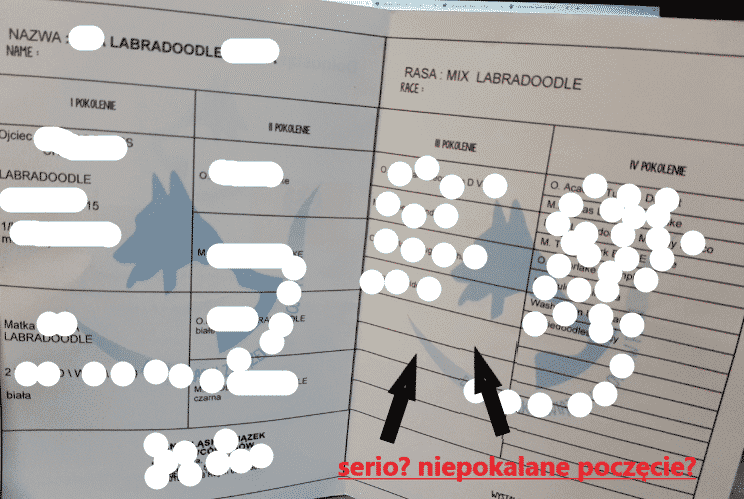
If you do not want to be misled, look for a dog from a breeder belonging to one of the organizations listed above. Yes, you may have to wait. The alternatives are simply imitations.
Breeders in those five organizations are PROHIBITED from selling puppies through OLX, Allegro and similar marketplaces.
AND NOW, A WORD TO THE PERSON TRYING TO PROFIT AT THE EXPENSE OF PEOPLE AND ANIMALS!
Can you really reproduce all this simply because you have a Labrador and your neighbor has a Poodle? Not really: this is a distinctive GENOTYPE. To reproduce it properly, you would need to follow the same decades-long process as Beverley Manners, introducing other breeds at the right times and for the right reasons. Breeding Labradors, Poodles and their descendants for a few generations is not enough. You would also need to study and observe entire litters for at least a year, selecting only dogs with the desired qualities — balanced temperaments and nonshedding coats — for further breeding and pairing those dogs with one another. The scale becomes substantial, doesn't it? You would need a research center: how else could you observe so many dogs in fifty or a hundred square meters? As successive generations developed, you might need to introduce another breed, perhaps an American Cocker Spaniel, to expand the gene pool or address a defect. You would also need to know exactly why and when you introduced it; the timing cannot be random. Once you resolve one trait, remember the other side of the coin: the puppies now inherit genes from both parents. Spaniels, in case you did not know, change their coats three times a year. You would need to observe which of your now-adult puppies shed, because you cannot establish that in a young puppy. If you want to be honest with clients who have allergies, you absolutely cannot breed from those dogs. Still think it is straightforward? Wait; there is more. Over successive generations, keep observing and carefully introducing appropriate breeds when temperament becomes difficult, coats shed, or a woolly coat needs loosening. Do not give up, even though the road is hard and uneven. It may be worthwhile, especially when you finally achieve something unique and can be proud. Unless someone then comes along, dismisses everything you know about breeding, and mates a dog you sold under a delayed-neutering agreement with an unrelated village dog. Seven puppies are born and sold using your good name. A process begins that you cannot stop. Five years later, people may no longer know who you were or what you accomplished. More importantly, they assume this other person's puppies are the same thing — and soon those prices may even exceed yours.
Let me tell you something else. Recently, a buyer from just such a breeder called, upset that ALFA-Europe would not register his female dog. He could not understand why I would not let him use my male Australian Labradoodle for breeding. He thought I was afraid of competition. He did not realize he had an untested mixed-breed dog and had been deceived. He even sent a photograph; the poor dog looked unwell at first glance. He calls several times a month to ask what right we have to refuse. His breeder told him we register even F1 dogs and that this was why the breeder would not issue a pedigree: we supposedly issue them. Despite repeated explanations, he still believes we fear competition. This is the outcome of those shortcuts. It was people doing this that Wally Conron regretted when he spoke of creating a monster. If you read his words carefully, he was not regretting the Australian Labradoodle but what followed: people seeking profit through deception at the expense of other people and animals.
Do you now understand why those five organizations require dogs not intended for breeding to be spayed or neutered? To prevent them from falling into hands that could undo the work those breeders have done. Of course you can become a breeder and continue developing this wonderful breed. Choose someone from one of those organizations, and they will help. You will need to accept rigorous codes of ethics and breeding rules, substantial responsibilities and costs several times higher. Perhaps you already know all that — and that is why you take the easy route.
Continue exploring
A Breed or a Mixed-Breed Dog? — The difference between a planned breeding program and a chance litter.
Breed Associations — The organizations and standards behind the breed.
Is Your Dog an Australian Labradoodle? — Recognizing responsibly verified ancestry.