about the breed
A Breed or a Mixed-Breed Dog?
A story about breaking new ground, understanding breeds responsibly, and why truth, passion and honest intentions in breeding ultimately have to speak for themselves.
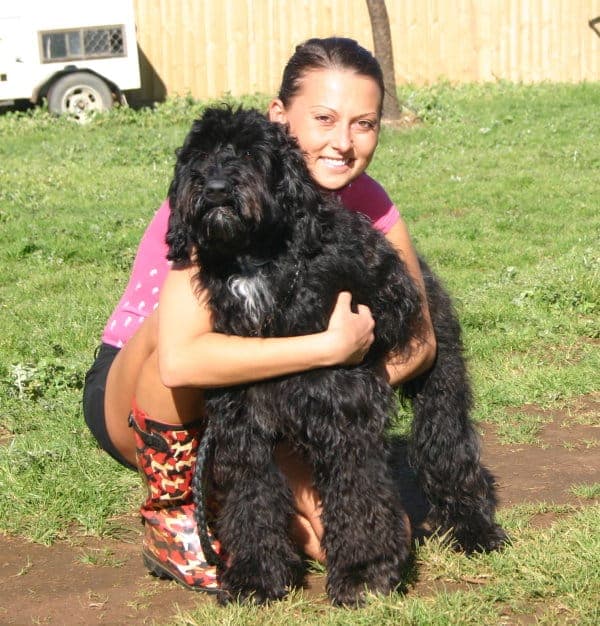
Eighteen years ago, I committed a terrible crime. Oh yes, an enormous one! I brought Australian Labradoodles from Australia to Poland. The shocked internet buzzed with discussions of how I should be publicly condemned. I simply do not read that sort of thing. I know online HATE has always existed and always will. Since being first and breaking new ground is never easy, I try to live by a certain principle.
'All truth passes through three stages: first it is ridiculed, then it is opposed, and finally it is regarded as self-evident.' This is my favorite Schopenhauer quote. I am convinced that more than one of those online critics has become interested in the breed and contacted me over the past 18 years.
I know that truth, passion, love for what you do and, above all, honest intentions will ultimately stand up for themselves. Always.
I have already explained my position on A BREED OR A MIXED-BREED DOG? in another article.
New dog breeds continue to be developed and registered, while established breeds are still being damaged through increasingly flattened faces or exaggerated rear angulation. I think the world would look different if people focused on improving themselves and polishing their own rough diamond each day.
When we hear the word breed, it is easy to imagine something that has always existed: unchanging, closed and given to us by nature. The truth is quite different. Every dog breed was developed by people at some point. None fell from the sky complete with a pedigree and breed standard.
Breeds developed because people needed dogs with particular traits: hunting, herding, pulling sleds, guarding homes or providing companionship. Breeders selected dogs with the desired qualities and paired them. Over successive generations, they selected offspring that best met the intended purpose. That is how selective breeding works.
The Eurasier is a good example: a relatively young breed, only a little older than the Australian Labradoodle, whose development began in the twentieth century by combining selected breeds and continuing selection over many generations. The aim was not random mixing, but dogs of a particular type, temperament and characteristics that could be consistently established.
The Eurasier was developed from three breeds:
Chow Chow
Wolfspitz / Keeshond
Samoyed
Today it is a breed registered by ZKwP, the Polish Kennel Club.
The Pudelpointer has a similar history. It developed from Poodles and Pointers, but that does not make every Pudelpointer a random cross between those breeds. The initial crosses were followed by extensive breeding work, selection and establishing desired working qualities. A population with its own distinctive type emerged over time.
This is the important distinction between a single mating of two dogs and a long-term breeding program.
An Australian Labradoodle is not simply a Labrador crossed with a Poodle. Today's Australian Labradoodle is the result of deliberate, multigenerational selection toward a defined goal. Over the years, breeders have selected for health, temperament, structure, coat type and other qualities important to the population. As with any developing breed, the process takes time, knowledge, consistency and many generations. The development of the Australian Labradoodle has been more reliable, organized and closely controlled than the development of breeds in the past. Why? From the outset, we have had access to technology: dogs underwent DNA parentage verification and genetic disease testing, and inbreeding levels were kept low from the beginning.
Compare that with histories of some breeds whose supposed ancestors are described vaguely as 'other farm dogs.' With Australian Labradoodles, there is no room for 'other spaniels,' 'other terriers' or 'other companion dogs.' The process was closely controlled from the start, leaving no room for guesswork or vague possibilities. Trust is good; verification is even better.
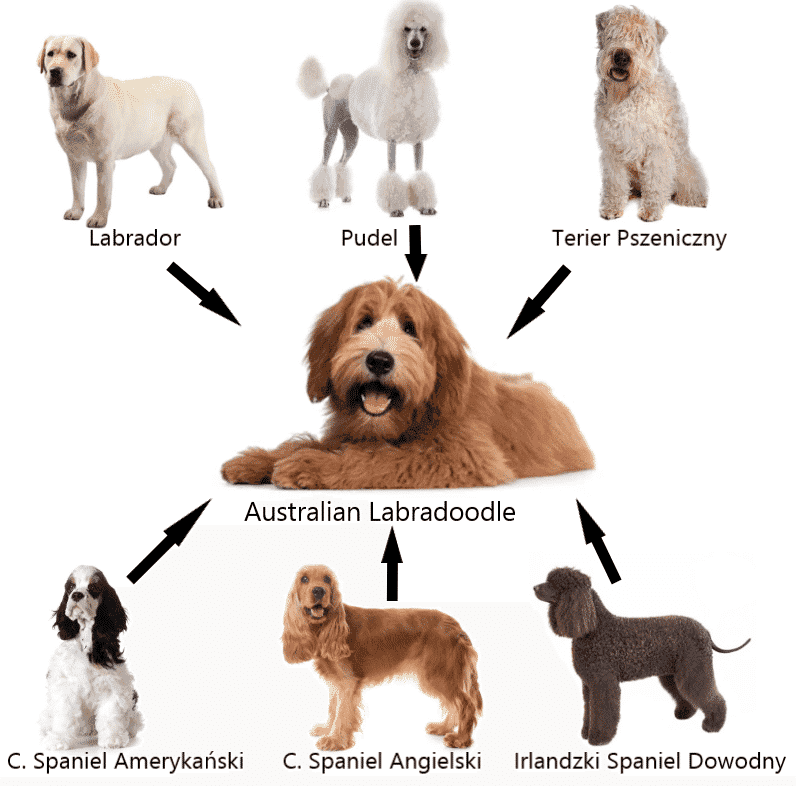
Australian Labradoodle Ancestors
We can certainly discuss the history, standards or direction of individual breeds. But we cannot pretend that older breeds developed by themselves while only new ones were shaped by people. Every breed was once new. Every breed had a beginning. Every breed resulted from selection, breeding decisions and human work. Older breeds, however, developed before widespread internet access and the universal opportunity to express criticism online. They could not become widely publicized through the press and internet in the same way. That was their advantage: a quieter development process without the excessive popularity exploited by irresponsible breeders.
The difference is simply that some breeds have a hundred or two hundred years of history behind them, while others are earlier in their journey. Here we are talking about almost 40 years of work — not such a short period, considering that the Eurasier is around 66 years old.
Before asking why anyone should create something new, remember that the same question could once have been asked about many breeds we now regard as familiar and firmly established.
No dog breed fell from the sky. Every breed has a history. The Australian Labradoodle's history is simply still being written.
Australia, socialization and the breed's beginnings
Continue exploring
Breed History — Where the breed originated and how the idea developed.
Breed Standard — Key characteristics, proportions and temperament.
Breed Associations — Why pedigrees, associations and transparency matter.