about the breed
Australian Labradoodles for People with Allergies?
People with allergies sometimes choose Australian Labradoodles, but no two allergy cases are alike. A dog's ancestry, coat type, breed association and a person's individual response all matter.
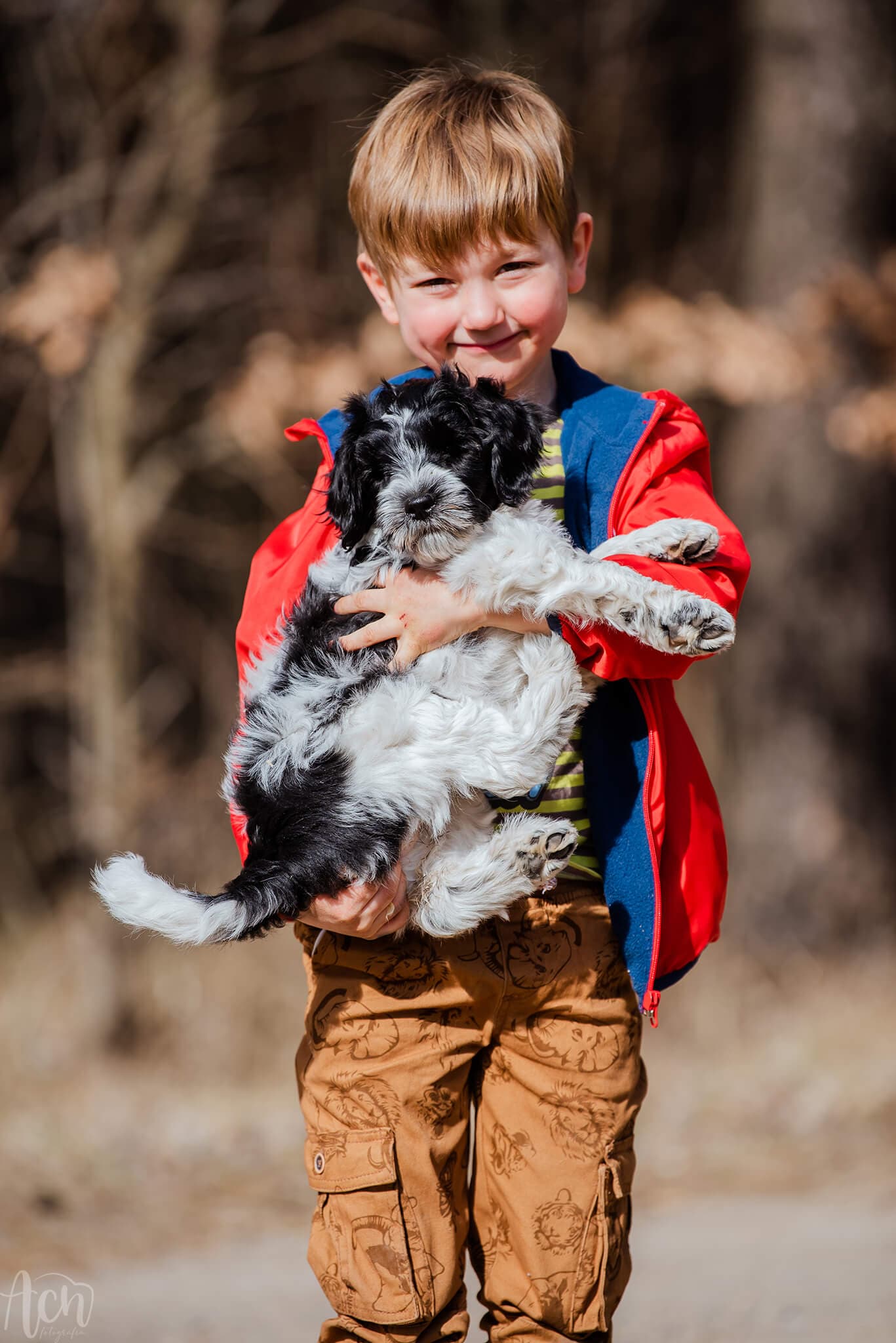
Australian Labradoodles and Allergies
Australian Labradoodles for people with allergies. As you probably know by now, an Australian Labradoodle is more than a Labrador–Poodle cross.
Choosing a dog from the earliest generations — a Labrador crossed with a Poodle, a Labradoodle crossed with a Poodle, or a multigenerational ALD crossed back to a Labrador or Cocker Spaniel — can unfortunately lead to unpleasant surprises.
Even a year later, after a Labradoodle puppy's first coat change, you may discover that your dog triggers allergies and sheds.
Why shedding can occur
Why does this happen? You never know exactly which genes your puppy will inherit. Perhaps the puppy will have the shedding coat of a Labrador mother or a Cocker Spaniel father.
In general, associations should move away from early generations of Australian Labradoodles and should not introduce new breed infusions. I realize, however, that not all associations have these rules.
Unfortunately, you can still encounter an Australian Labradoodle whose father is a Poodle, Cocker Spaniel or Soft Coated Irish Wheaten. In such cases, you must allow for the possibility that your dog will shed and trigger allergies.
Unfortunately, this may not become apparent until a year later, after the first coat change.
Why the association matters
It is therefore particularly important not to choose a dog from such early generations. Ideally, choose an association that does not allow these crosses. This gives us confidence in the quality of the dog we are buying.
Not everyone reacts only to the coat
The second consideration is the person with allergies. Not everyone reacts only to hair. A person may be sensitive to allergens in saliva, dander, hair and even urine.
In my experience, reactions to proteins in urine are the strongest. In this situation, the breeder should first arrange a meeting with an adult dog in conditions free from those allergens.
The breeder should then provide comprehensive guidance on caring for the puppy in a way that minimizes the risk of allergic reactions.
Poor nutrition, neglecting coat care or allowing a puppy to relieve itself indoors can contribute to allergic reactions.
I discuss allergies in more detail in another article on this website, which I encourage you to read. My breeding program focuses mainly on families with allergies. As someone with allergies myself, I know exactly how difficult it is to hear, 'You cannot have a dog.' That is why education about minimizing risk is such an important part of my work. Simply getting a dog with a so-called allergy-friendly coat does not guarantee that no reaction will occur. Following the introduction guidelines I have developed over 18 years, however, improves the chances considerably. Please get in touch!
Continue exploring
Allergies and Shedding — Shedding, allergies and each household member's individual response.
Coat Types and Colors — Coat textures, colors and realistic expectations.
Breed Associations — The organizations and standards behind the breed.