about the breed
Breed Standard
The standard describes the Australian Labradoodle's proportions, temperament, head, eyes, ears, movement, coat and colors. It provides a reference for evaluating the whole dog without exaggeration or guesswork.
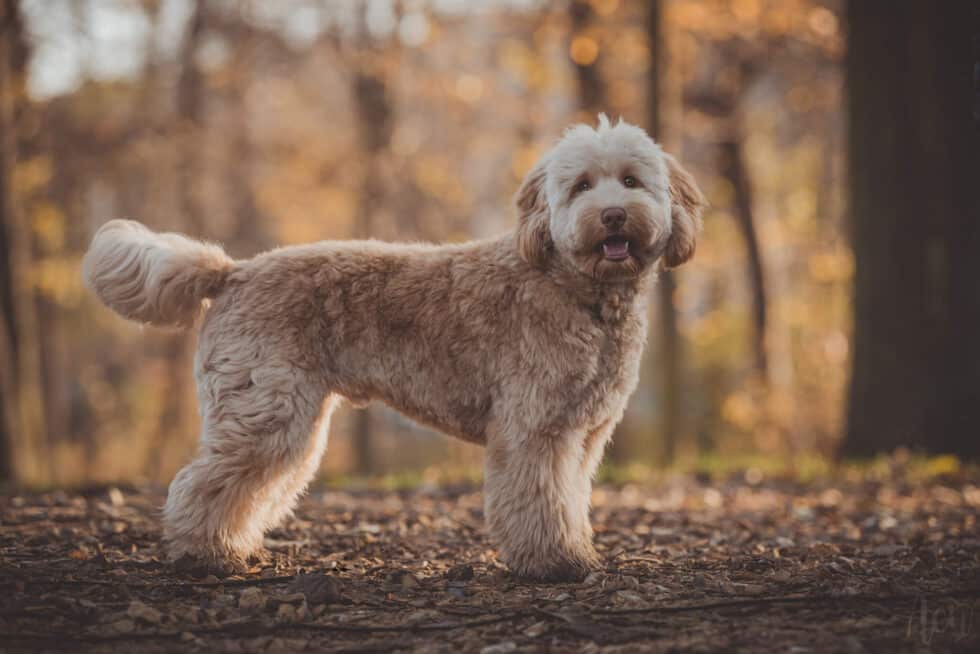
General Appearance and Size
Graceful, compact and balanced, with a friendly, very cheerful manner and a highly intelligent expression. The temperament is intuitive, and movement is light-footed yet athletic.
Size and weight should be proportionate. Actual size matters less than overall balance and freedom from exaggeration. The dog is slightly longer than tall, with height-to-length proportions of ten to twelve.
Three sizes are distinguished: Miniature, below 45 cm; Medium, between 45 and 60 cm; and Standard, above 60 cm.*
The spine and ribs should not be prominent beneath the coat, and the dog should not be excessively heavy.
*Height and weight are biological traits influenced by many factors beyond genetics. As with other breeds, final size cannot be absolutely guaranteed.
Temperament
Friendly, lively and cooperative with people, seeking eye contact and, above all, people-oriented.
Head, Eyes, Ears and Bite
The skull is moderately broad, not domed, with defined occipital contours. The distance from nose to occiput is slightly longer than from the top of the skull to the occiput. The muzzle is broad, with close-fitting lips and flews. A substantial, fleshy nose is characteristic; a small, pointed, narrow or pinched nose is undesirable.
The face should appear curious and gentle, lively yet sweet, with a clear, engaged desire for eye contact.
Eyes are set well apart and are round or oval. They should be neither sunken nor protruding, and drooping eyelids are a serious fault. Long eyelashes are characteristic.
Eye color should complement the dog's pigmentation. Hazel eyes occur with chocolate, caramel and café-au-lait pigment. Black and cream pigmentation are most often associated with dark-brown eyes. Blue eyes or two differently colored eyes disqualify a dog from breeding. A piercing, harsh or expressionless look is a serious fault.
Ears are set widely at the sides of the head, hanging slightly below the skull line and raised a little at the base to improve airflow.
A scissor bite is strongly preferred, although a level bite may be accepted in an individual of particular merit in conformation or temperament. Teeth and gums should be healthy and strong. A wry, overshot or undershot bite disqualifies a dog from breeding.
Neck, Topline and Limbs
The neck is slightly arched, muscular and strong, of moderate length, flowing gracefully into the topline. The topline is level, dropping gently just behind the withers and sloping slightly over the hips toward a low-set tail.
The body is well proportioned, with a moderately deep chest, free from exaggeration. The tail is saber-shaped and set low from a slightly sloping croup. In excitement it may be carried happily above the back, but a tail curling and twisting over the topline is a fault.
Forequarters: muscular, well-developed shoulders without heaviness. Shoulder blades are relatively long and broad, with normal angulation. Elbows turn neither outward nor inward and sit well forward against the ribs. Forelegs have strong bone and stand vertically to the ground, with short, strong pasterns.
Forelegs must not be too short, as this pulls the dog downward, places strain on tendons and joints and detracts from overall quality.
Hindquarters: broad, strong, well-muscled thighs with balanced angulation. The distance from stifle to hock is greater than the distance from hock to ground.
Feet
Compact and strong, with well-arched toes and an oval or round outline. Pads are thick and nails short. The dog is born without rear dewclaws. Hare feet are a major fault.
Coat
There are two single-coat types: wool and fleece. The coat is a highly characteristic feature and is prioritized after conformation and temperament.
Wool coat: the appearance and texture are closest to a Poodle's. The coat is trimmed to a similar length on body and legs. Feet are clipped short, but not up to the ankles. The tail remains fully coated. The head and muzzle should not be shaved, although scissor trimming is appropriate.
Fleece coat: gently curly or wavy, with a similar length on body and legs, presented full and long. Facial hair is trimmed to reveal the eyes. Feet are clipped short only to heel level, with the clipped areas covered by coat hanging from higher on the legs.
Feet must not be shaved up to the ankles as in a Poodle trim. Tail hair should remain longer and flowing.
The Dog in Motion
At a trot, the dog appears to float over the ground effortlessly. Movement is agile, athletic and very light, giving the impression of cheerfully traveling in a chosen direction.
Viewed from the front or rear, the legs should not turn inward or outward. As speed increases, footfall converges toward the center of gravity. Viewed from the side, limbs should extend smoothly, without lifting or bending excessively upward.
Hocks are short and strong, well angulated and carried forward beneath the body.
Colors
lavender
parchment
silver
black
blue
chocolate
shades of cream, caramel and apricot
red
café au lait
Parti-color, combining one of the colors above with cream or white, is also accepted but not promoted.
Summary of Faults
Males with undeveloped testicles at six months or older, together with any departure from the breed standard.
Source: Kynologia, the quarterly journal of the Polish Purebred Dog Club, issue 1/2012 (31).
Proportions, outline and breed expression
Continue exploring
Breed History — Where the Australian Labradoodle idea began and how the breed developed.
Temperament — Personality, needs and everyday life with an Australian Labradoodle.
Health Testing — Health examinations, genetics and responsibility within the breeding program.