A Puppy at Home
Stop That Puddle!
A Survival Guide for New Dog Owners
Part I: Understanding Your Puppy — Do Not Expect Miracles
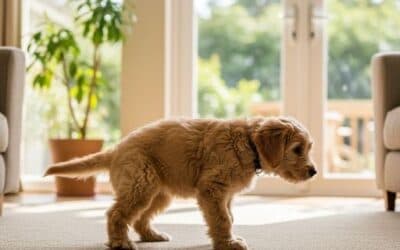
Toilet training is a process, not a sprint. Like any process, it begins with understanding who — or what — we are working with. A puppy is not a miniature adult dog, but more like a baby on four paws: adorable, vulnerable and completely unaware of having just peed on your new rug.
1.1. Tiny Bladder, Little Control
Puppies, especially at eight to twelve weeks, have tiny bladders and little control over emptying them. This is not spite; it is physiology. Their bodies cannot yet reliably hold urine. When they need to go, they need to go. That is all.
As a general rule, a puppy may hold on for roughly their age in months plus one hour. A two-month-old puppy might therefore manage three hours. Might, not must: puppies often need to go after playing, drinking, eating or sleeping, even if your planned interval has not elapsed.
Remember: struggling to hold on is not the puppy's fault. Helping is our responsibility.
1.2. The Brain Needs Time Too
Dogs learn where to toilet through consistency, repetition and positive experiences. A puppy cannot yet connect an accident with wrongdoing, especially while a person shouts or waves their arms. The puppy responds to the emotion without understanding why: shouting means confusion, stress and more accidents.
Your puppy is not trying to upset you; they do not understand yet. Rushing over while a puppy is already going, hoping to whisk them outside, can do more harm than good. The puppy may become frightened and avoid toileting in front of you. Charging toward the puppy also sends strong threatening signals: from the dog's perspective, you are rushing in to attack, even though you intend to pick them up and carry them outside.
1.3. Developmental Stages — What to Expect and When
Some dogs learn faster than others. This is not a race. Comparing your puppy with a neighbor's dog who learned in a week creates frustration and unnecessary tension.
1.4. Signals We Miss When Our Puppy Is Trying to Tell Us Something
Puppies usually signal that they need to go; we may simply fail to read the signs.
Common ways of saying, “Hello, I need to pee!” include:
suddenly stopping play and circling in one spot;
intently sniffing the floor;
whimpering;
walking in circles or looking for a corner;
restless behavior after waking or eating.
Learning to read these signs gives you a major advantage. It is not fortune-telling, just basic communication.
Understanding Your Puppy's Needs
Recognize natural expectations
Understand the puppy's needs.
Lead with empathy
Approach the puppy with empathy.
Avoid negative methods
Avoid negative training methods.
Observe and learn
Learn by observing the puppy.
Be patient and consistent
Show patience and consistency.
Part II: Routines and Rituals — The Foundation of Success
Let us be clear: without routine, toilet training is much harder. Puppies love predictability because it helps them feel safe and learn faster. People often prefer to play things by ear, but a daily plan can save both our rugs and our patience.
2.1. The Golden Rule: A Toilet Trip after…
After what? Almost EVERYTHING. A puppy is a walking bladder, so:
A useful tip: even if your puppy went an hour ago, take them out again after waking.
2.2. A Toilet Diary — Funny-Sounding, but Effective
You do not need to write a novel. A notebook or phone app is enough to record:
feeding times;
toileting times, including accidents;
where it happened;
what the puppy was doing beforehand.
After a few days, patterns emerge. Once you recognize them, you can anticipate the next toilet trip and act in time.
2.3. Regular Meals Mean More Predictable Toilet Times
A sample schedule for a ten-week-old puppy:
Yes, it is a lot. But with this approach, your puppy may become reliably clean within two to four weeks, and things get easier afterward.
2.4. Too Late Is Our Mistake, Not the Puppy's
If a puppy pees in the middle of the living room, it usually means:
someone missed a signal;
the puppy waited too long for a trip outside;
excitement became too much to hold on.
In other words, the puppy did not fail. We did.
There is no need for self-blame; improve the system. Sometimes all it takes is:
one more trip outside each day;
a quicker response after waking;
less freedom to roam, which we will discuss later.
2.5. How Often Is Often Enough?
That depends on age. Younger puppies need more frequent trips outside.
IMPORTANT: every toilet trip counts, including a two-minute one. The purpose is not a long walk but an opportunity to go. However, do not head inside immediately afterward. Wait another minute or two so toileting does not become the signal that outdoor exploration ends. Otherwise, a puppy may hold on outside to keep exploring and pee as soon as you get home.
The Puppy Routine Cycle
Establish a feeding schedule
Regular feeding establishes a routine.
Observe toilet timing
Notice patterns after meals.
Adjust the schedule
Make adjustments as needed.
Keep the home clean
Consistency helps maintain cleanliness.
Part III: Support at Home and Good Habits — From Floor to Ceiling
Now let us look at what happens indoors. Even the best schedule cannot help if a puppy does not know where to go, when rewards happen or why the rug smells like a public restroom.
3.1. A Designated Toilet Spot — Your Secret Weapon
Your puppy needs to know where to go. Confusion about location means more accidents. The spot should be:
consistent;
easy to reach;
quiet, without distractions;
on a natural surface such as grass, gravel or soil when outdoors.
If you are teaching outdoor toileting, do not change the location or route every week. Routine helps.
If you use a puppy pad, choose one place indoors rather than moving it around like a decorative accessory.
3.2. Rewards — That Important Moment Immediately Afterward
Did your puppy go in the right place? Celebrate, but thoughtfully.
Reward:
immediately after finishing, not ten seconds later;
outside, rather than after returning home, or you reward returning instead of toileting;
with something appealing: a tiny treat and enthusiastic praise, as if the puppy had just won an Oscar for the best pee.
Avoid:
a big performance while the puppy is still going, which may interrupt the process and leave the rest for the living room;
rewards without a clear reason: your puppy is learning that going HERE earns THIS.
3.3. Puppy Pads — Help or Pitfall?
This is controversial, so let us be direct.
A pad can help when:
you cannot reliably reach outside in time, perhaps because you live on the fourth floor without an elevator, especially in winter or rain;
the puppy is very young and still developing control;
your work schedule sometimes makes timely trips difficult.
A pad can also get in the way when:
you treat it as a permanent solution rather than a temporary one;
the puppy toilets beside it because the surrounding smell also suggests permission;
you are allergic to proteins in urine.
Treat pads as a temporary stage. Gradually move the pad toward the door, then remove it altogether.
3.4. What about Crates, Playpens and Limiting Space?
This is not about a prison, but a useful tool. Dogs naturally prefer not to soil their sleeping place, so providing a small, comfortable area can help:
make waiting for a trip outside easier;
speed up toilet learning;
reduce accidents and make them easier to manage.
An appropriately sized crate or enclosed playpen is a learning space, not punishment.
Less space means more supervision, fewer accidents and a calmer caregiver.
3.5. Cleaning an Accident — It Is Also about Smell
This is not just housekeeping; it is behavior. Dogs follow their noses. Without neutralizing the odor:
your puppy will keep returning to the same spot;
that spot will seem like an approved toilet.
What should you use?
Enzyme cleaners designed for pets break down odor compounds.
Avoid chlorine, lemon and vinegar: they may disguise the smell for you without removing it for your dog.
Keep these ready:
paper towels;
an enzyme spray;
barriers to restrict access to favorite accident spots.
The Puppy-Training Pyramid
Remove lingering odors
Remove odors to help prevent repeat accidents.
Limit the available space
Limiting space supports training; it is not a punishment.
Use pads temporarily
A puppy pad is a temporary tool, rather than a permanent solution.
Reward promptly
Prompt rewards reinforce good habits.
Set clear boundaries
Provide clear rules and boundaries for the puppy.
Part IV: Common Mistakes — and How NOT to Make Them
If you have ever cried, “Why the rug again?”, welcome to the club. Even experienced caregivers can make these common mistakes. Each can be corrected — or, better still, avoided.
4.1. Too Much Freedom Means More Opportunities for Accidents
An unsupervised puppy may simply go somewhere because nobody is watching and the rug looks rather like grass.
The mistake: “Let the puppy explore the whole house and get used to it.”
Try instead: “Until toilet habits are established, use a limited area — a crate, pen or one room — with supervision.”
The rule is simple: if you cannot see your puppy, expect a surprise.
4.2. Punishment after the Event
It is a familiar scene: you find a puddle, call your puppy, point at the evidence and say “Bad dog,” or worse, take the puppy over to explain what they did.
The problem: your puppy does not connect those events across time. They wonder why you are angry when they approach. Next time, they may choose a hidden spot, perhaps the bed, where you might not notice.
Try instead: ignore the accident, clean without a fuss, work out why you missed the opportunity and respond sooner next time.
Dogs learn through associations, not guilty consciences.
4.3. Not Going out Often Enough
Many toilet-training problems come from too few trips outside rather than anything wrong with the dog.
“But we went an hour ago!” Yes, but since then your puppy has:
eaten;
had water;
played with the children;
been petted by the neighbor.
All of that means excitement plus a full bladder.
The mistake: assuming a puppy should be able to hold on.
Try prevention: go out before it becomes urgent, not after an accident.
4.4. Rewarding Too Late
If you reward only after returning indoors, guess what happens? The puppy rushes home for the treat and pees in the hallway — or does not go outside at all.
The mistake: “Well done for peeing!” five minutes afterward.
Try rewarding immediately after the puppy finishes, while you are still outside. You can also add a cue: as the puppy begins, say “Go potty.” Before long, the cue may help prompt toileting.
It need not be a feast: one favorite treat and a proud, pleased voice are enough.
4.5. An Unclear Message about What Went Well
We often praise a dog after a walk without explaining why, or praise so generally that the dog cannot identify what earned it.
The mistake: rewarding the walk rather than toileting outside.
Use a clear sequence: wait for the puppy to finish, praise immediately, give a treat and then return home.
You can introduce separate cues for peeing and pooping. Over time, the dog connects them with the action, which is useful during travel or a quick trip outside.
4.6. Relying Too Heavily on Puppy Pads
It bears repeating: a pad is temporary help, not a way of life.
The mistake: leaving pads indefinitely because an occasional accident still happens.
Make a removal plan: gradually reduce availability and move the pad toward the door until it disappears from the routine.
4.7. Inconsistency between Household Members
You teach outdoor toileting, but your partner sometimes allows the pad. The children miss nervous circling, and Grandma feeds the puppy at ten at night.
The mistake: everyone follows a different system.
Agree on one simple, written plan with rules everyone follows.
Your dog cannot understand rules that change depending on who is standing by the door.
Avoiding Common Dog-Training Mistakes
Plan ahead
Avoid punishment after the event to make training more effective.
Reward thoughtfully
Use rewards to reinforce positive behavior, rather than undermine it.
Agree on a family approach
Involve the whole family to keep training consistent.
Part V: Maintaining Progress and Living with Fewer Surprises
This section looks at preserving good habits, avoiding accidental setbacks and managing situations that disrupt your dog's routine and your peace of mind. Life is unpredictable, but you can be prepared.
5.1. When Can You Consider Your Dog Toilet Trained?
It is a common question. Look for these signs:
at least two to three weeks without an accident;
your dog signals the need to go out, perhaps approaching the door, whining or circling;
your dog toilets regularly outside rather than after returning home;
you can leave for a few hours and return to a clean floor.
This does not mean you will never think about toilet habits again, but you can shift from teaching to maintaining them.
5.2. Weather, New Places and Travel — Avoiding a Return to Square One
Your dog may do beautifully at home, and then:
it rains: “I'm not going out. It's cold.”
you visit friends: “Oh, a new rug!”
a hotel, new home or unfamiliar smells prompt: “Where is my bathroom?”
Do not panic. This is often a normal response to a change of surroundings, not a complete loss of learning.
In a new place:
use a leash and show your dog the toilet spot;
reward the first success, confirming that familiar rules apply here too;
watch closely for the first few days, as at the beginning. Prevention is easier than cleaning.
5.3. Changes in Daily Routine — Handling Them Well
Vacations, a new job, renovations, visitors, another dog or a baby can turn a schedule upside down. Dogs rely on routine, so changes can affect behavior.
The principle: when things change, briefly return to the basics.
You do not need to start over, but:
provide more frequent toilet trips;
watch again for early signals;
reward successes as if it were day one.
This works and reassures your dog that you are still a team.
5.4. A Setback? Take Action, Not Offense
Sometimes a dog unexpectedly has one or two accidents. What then?
The worst response is anger and the belief that all your work was wasted.
The best response is to look for a cause:
Was your dog alone too long?
Has something changed in the diet?
Was there a stressful experience?
Has your daily routine changed?
Treat it as information that something is not right, and return temporarily to closer supervision.
5.5. Adult Dogs Who Have a Setback
Toilet difficulties are not limited to puppies. Adult dogs may struggle after:
trauma;
time in a shelter;
a change of home;
illness, which can disrupt established toilet habits.
The approach for an adult dog is similar:
Limit the available space.
Provide frequent trips outside.
Reward success.
Use no punishment.
Combine observation with routine.
The good news is that adult dogs often learn faster because they can hold their bladder longer and make associations more readily.
5.6. Toilet Training Is a Process, Not a Straight Line
Remember that learning includes ups and downs. What matters is:
maintaining a routine;
not reacting emotionally to accidents;
recognizing progress;
being patient — yes, that word again.
Most importantly, keep perspective. In a few months, you may be telling people how your puppy once peed on the curtains and now only goes on the grass, feeling enormously proud.
Maintaining Progress and Handling Setbacks
Work together
Cooperate with your dog toward success.
Reinforce the training
Focus on applying the training consistently.
Teach older dogs again
Older dogs can still learn.
Handle changes
Treat changes as tests of the routine.
Respond to setbacks
Focus on how you respond, rather than on the setback itself.
Part VI: Your Role, Patience and Mindset — Staying Sane without Throwing the Dog Bed out the Window
6.1. Understanding Your Dog's Perspective
Begin with empathy. Your puppy is not spiteful or deliberately upsetting you. A rug does not become an obvious no-toilet zone until you teach that distinction.
Imagine moving to Japan and being expected to understand every cultural rule on day one without explanation. That would not work either.
A dog needs time to connect the pieces:
place + moment + need to go = success + reward.
Your puppy cannot read your mind or understand “How many times must I tell you?” Learning depends on associations and repetition, and you are the teacher.
6.2. The Mindset: This Will Pass — It Really Will
Puppyhood is intense and sometimes messy, but temporary. Every reliably toilet-trained dog once had accidents.
Even if:
you have just stepped barefoot into a surprise;
you are cleaning for the third time today;
it feels as if this will never end…
IT WILL PASS.
It may happen sooner than you think if you remain consistent. Sometimes a few weeks of a good system bring years of easier living.
6.3. Patience Is a Choice, Not a Special Gift
Some people do not possess a magical extra supply of patience. They choose not to be ruled by emotion. You can too.
Instead of:
get angry;
say your puppy will never learn;
search forums in a panic;
Or you can:
take a deep breath and a long exhale;
remember the plan;
return to the basics and keep going.
A useful tip: record successes, however small. “No accidents today!” is worth seeing on paper when confidence dips.
6.4. Mistakes Are Part of Learning, Not a Disaster
No system is perfect. Even with a spreadsheet, a two-hour alarm and a GPS tracker, accidents happen.
But those moments provide information: something did not work, and you can investigate what it was. That is useful.
They help you:
improve your approach;
understand your dog;
become a stronger team.
The worst response is to get angry and give up.
The best is to accept that this is part of the journey and continue.
6.5. Look after Yourself Too — Seriously
It sounds obvious, but tired people become frustrated, and frustrated people may shout at a dog for something the dog does not understand.
So:
sleep when the puppy sleeps, just as with a baby;
eat proper meals rather than grabbing a snack between walks;
ask your partner, children or neighbor for help. You do not have to do everything alone.
A calm, balanced caregiver helps a puppy learn. Dogs read us like an open book, and frustration is not a helpful starting point for toilet training.
6.6. Do Not Compare Your Puppy with Others
“My friend's sister had a dog who was toilet trained at eight weeks.” “Someone on Facebook said their Labradoodle opened the door and used the toilet by himself…”
STOP.
Every dog is different, and so is every person. This is not a race. Your dog is not a benchmark, but an individual learning at their own pace.
Your dog needs your presence, calmness and consistency, not pressure.
Patience and Mindset When Working with a Dog
Patience
Essential for implementing a plan effectively and understanding a dog's needs.
Understanding
Recognize that dogs learn at their own pace and do not act out of malice.
Learning from mistakes
See mistakes as opportunities for development, rather than a source of stress.
Looking after yourself
Maintaining your own well-being supports better results when working with a dog.
Individual progress
Focus on your own progress instead of comparing yourself with others.
Good Luck — You Can Do This!
Written by Edyta Gajewska. Copying, modifying or distributing these materials, in whole or in part, without the author's permission is prohibited.