Raising a Dog
He Knows What He Did Wrong
Is it really okay to humanize our puppies? Can thoughtful parenting offer useful lessons for raising dogs?

A Dog Is Not a Little Human, but…
Imagine a tiny puppy with round eyes and soft ears arriving in a new home. Everyone falls in love at once, responding to every sound, movement and glance. “He loves me!” “She's jealous of the cat.” “He did it deliberately because he's upset.” Sound familiar?
There is nothing wrong with loving our dogs. They become family members, emotional companions and partners in everyday life. But love can make it easy to cross a subtle line, assigning human characteristics, feelings and motivations to them. That is where difficulties begin.
Humanizing dogs, especially puppies, is a trap. Instead of understanding their actual needs and signals, we interpret behavior through our own experiences. What looks like anger or jealousy to us may be stress, insecurity or difficulty coping. Instead of helping, we may cause harm.
But let us not throw the baby out with the bathwater — or the puppy out with the carrier. Although a dog is not human, puppy development has much in common with a young child's development. That is worth considering, not to dress dogs in baby clothes and put them in high chairs, but to learn from approaches that genuinely help: safety, confidence, growing independence and a calm adult presence.
Today I want to challenge myths about canine emotions and show why humanizing dogs can be harmful, even when motivated by love. I also want to look at puppy development through useful lessons from raising children. A dog is not a child, but deserves tenderness, empathy and thoughtful guidance.
What Is Humanization, and Why Can It Harm a Dog?
Common Examples — and What May Really Be Happening
1. “She's sulking.” A dog turns away or does not come when called after being scolded, looking like a haughty little princess. In reality, the dog may be avoiding contact because your voice, posture and tension create unease or fear. This can be an appeasing strategy, not emotional revenge. We see sulking; the dog is trying to avoid conflict.
2. “He did it out of spite.”
A dog pees on the rug just after you leave, chews a shoe or destroys a cushion.
3. “He wanted to teach me a lesson!”
In reality, dogs do not plot revenge. Behavior arises from emotions such as separation-related stress, boredom and frustration. They act in the moment rather than scheming. Destruction while you are away can mean, “I cannot cope. Help me instead of punishing me.”
4. “He knows he was wrong — look at him.” A lowered head, tucked tail and apparently guilty expression after a mishap do not mean guilt in our moral sense. The dog reads your tone and facial expression and adopts an appeasing posture to avoid conflict. It is an attempt to de-escalate, not a confession.

Why Can This Harm a Dog?
Humanization is not always harmless conversation. It can lead to:
1. Misreading Emotions and Needs
If you think your dog is sulking, you may miss actual stress signals. If you assume jealousy, you may overlook a need for space or clearer boundaries.
2. Inappropriate Responses from the Caregiver
Instead of helping in a difficult situation, you scold, take offense or treat your dog like a spoiled child. The dog becomes more confused.
3. Reinforcing Unwanted Behavior
Believing a dog acts out of spite can provoke an emotional response that unintentionally rewards the behavior with attention. Worse, punishment may come long after the event, making no sense to the dog.
4. Damaging the Human–Dog Relationship
A relationship built on misunderstanding is neither secure nor stable. The dog cannot simply be a dog because human projections keep taking over. Meanwhile, the caregiver feels manipulated or deceived by an animal who does not understand the script.
What Canine Emotions Are — and Are Not
Dogs feel emotions. They experience basic feelings such as joy, fear, frustration, curiosity, sadness, contentment and excitement. They do not have complex emotions requiring self-awareness and moral judgment in the human sense, such as envy, guilt, hatred or irony.
There is little value in analyzing a dog as if they were a soap-opera character. Learn the dog's language instead:
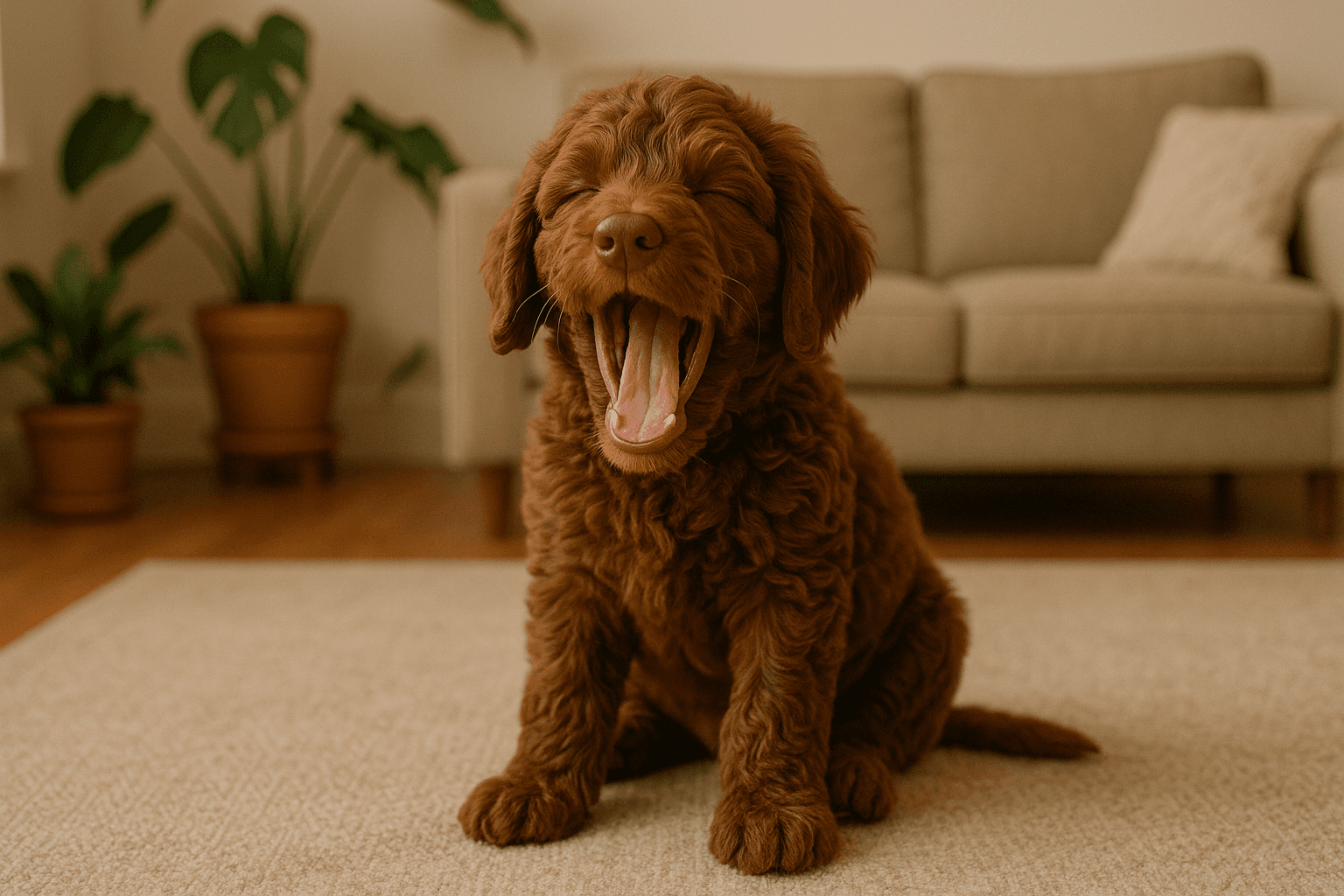
Yawning, head turning and nose licking can be calming signals rather than boredom.
Growling is communication, not malicious aggression.
Toileting indoors may signal stress rather than revenge.
Not responding to a cue may reflect distraction, confusion or emotional overload rather than teenage rebellion.
Understanding Dog Behavior
Yawning and turning the head
Calming signals, rather than boredom.
Growling
A form of communication, rather than malicious aggression.
Urinating indoors
A possible sign of stress, rather than revenge.
Not responding to a cue
Distraction, a lack of understanding or emotional overload.
Puppy Development and Child Development — What Do They Share?
We do not need to treat a dog as a child to recognize genuine parallels in development: in neurobiology, emotions and social needs.
This does not mean a dog is a furry baby. It means developing personality, security and life skills shares important features with child development. Approached thoughtfully, this can help us raise a stable, confident dog who copes well with stress.
Safety — The Foundation of Development
Neither puppies nor children develop well without feeling safe. Safety underpins curiosity, learning, play and relationships.
For puppies, as for children, the caregiver is a secure base. Your dog borrows courage from you. When you are calm, predictable and supportive, exploration becomes easier. When your responses are unpredictable, a dog may withdraw or respond with fear or aggression because other ways to manage anxiety are unavailable.
Does that sound familiar? Children work in similar ways. Child psychology describes attachment styles, and dogs also form attachment bonds with caregivers. The quality of that bond influences emotional development.
Exploration, Play and Learning — When It Feels Safe
Children and puppies learn by exploring: seeing, touching, sniffing, trying, making mistakes and discovering consequences. Stress, overload or punishment for every crossed boundary undermine that process.
First similarity: both need room to explore, along with boundaries and guidance.
We would not leave a child in a forest to raise themselves, but neither should we take every stick from their hand. With a dog, the aim is not unrestricted freedom but the thoughtful presence of an adult who helps distinguish safe experiences from unsafe ones.
Developmental Stages and Challenges — in Children and Dogs
Both children and dogs pass through sensitive periods and developmental challenges that affect behavior.
For puppies, these include:
Socialization, around weeks 3–12/14: learning about people, sounds, dogs, smells and objects. Experiences from this stage can have lasting effects.
Fear periods, around weeks 8–10 and again at about eight months, when unfamiliar experiences — and even familiar ones — may prompt strong fear responses.
Adolescence, roughly 6–18 months: hormonal change, growing independence, testing boundaries and apparent forgetting. It sounds like a human teenager for a reason. A final fear period may occur here too.
For children:
There are comparable developmental leaps, challenging phases around ages two and four and during adolescence, shifts between dependence and independence, separation anxiety and hormonal changes.
The key in both cases is calm, consistent, understanding support rather than taking behavior personally.
Developing Independence — Support Instead of Doing Everything
A child learning to walk will fall. That is part of learning. Constantly holding their hand prevents independence, while scolding every fall or always stepping in can create fear of failure.
The same principle applies to dogs. Your job is not to shield your dog from the whole world, but to prepare them to live in it.
Allow problem-solving and offer support in difficult moments, without removing every challenge.
Good guidance does not eliminate obstacles; it helps the learner manage them.
Communication That Builds Confidence
You might tell a child, “You can do it. Be brave.”
With a dog, words are not the main tool, although tone matters. You can communicate through your posture and behavior:
If the dog is startled, avoid panicking. Stay nearby and calm, like an anchor; you could even recite a poem in a steady voice.
Do not take over every social situation. Allow safe meetings with new dogs and exploration of places rather than constantly hiding your dog behind you.
Do not punish emotions; help your dog find other ways to express them.
Puppy and child development share several key needs:
Safety as a foundation;
Exploration and learning with support;
Room to make mistakes and learn;
A relationship with the caregiver as an emotional base;
Understanding during developmental challenges rather than panic.
This does not make a dog a child. It means we can draw on thoughtful approaches to raising children by supporting developmental, emotional and social needs, rather than projecting humanity onto a dog.
Care, Predictability and Autonomy — What Can We Learn from Parenting?
A dog not being human does not stop us learning from thoughtful parenting. Empathy, safety and support for independence can help across species.
The aim is not to treat a dog as a child, but to be the kind of guide we would wish to be for a child: calm, present, predictable and patient.
Here are three useful principles to bring from human parenting into life with dogs.
1. Care — Connection and Understanding, Not Indulgence
Care is not the same as spoiling. It means attentive presence, willingness to support and emotional availability. Those qualities underpin healthy attachment in children, and they matter to dogs too.
Your dog needs your emotional presence as well as your physical company. Being nearby is not the same as being available.
Gentle touch, affection and a calm voice can help a dog feel safe, provided the dog's right to decline contact is respected.
Recognizing emotions and responding appropriately is the kind of care that builds trust.
Care does not mean giving your dog everything they want. It means providing what they genuinely need, even when that includes boundaries, rest or structured learning instead of chaos.
2. Predictability — Safety Grows from Routine
Children enjoy rituals: familiar bedtime songs, stories and daily patterns that create a secure framework.
Puppies also benefit from repetition because it helps them understand the world.
Consistent walking, feeding and sleeping times are not a luxury; they support the nervous system.
Clear rules about permitted spaces, chew items and playtime build stability.
Predictability in the caregiver's emotions matters too. A dog may not understand your words, but notices your mood. Laughing at a behavior one day and shouting the next leaves the dog uncertain.
A predictable caregiver helps create a safe world and a calmer dog, just as with a child.
3. Autonomy — Everyone Needs a Chance to Cope
Good guidance is not constant control. Children and dogs cannot be raised by remote control. We can give them space to develop their own abilities.
For children:
We let children dress themselves, even when it takes forever;
We teach that they may say no, helping them establish boundaries;
We support attempts to solve problems instead of always supplying the answer.
With dogs:
Allow independent exploration in safe conditions;
Do not interrupt every attempt to reach a treat inside a toy, even if it takes time;
Respect a refusal of contact. If your dog moves away, do not press. This builds agency and a sense of control, important foundations for resilience.
“You Can Manage This” — A Useful Idea for Dogs Too
The point is not necessarily to say it aloud, although tone and energy matter, but to keep that idea in mind.
When a new sound frightens your dog, do not immediately whisk them away. Stay calmly beside them and avoid escalating the fear through your response.
When your dog is unsure how to step onto an obstacle, allow time instead of immediately lifting them.
When an attempt fails, encourage rather than taking over.
This is the same supportive principle used with children: do not do everything for them, shame or criticize them. Help them learn.
Practical Parenting Principles That Can Also Help Dogs:
The five-to-one principle: balance each correction with five positive reinforcements, such as praise, a treat, a smile, contact or play.
The first-impression principle: an initial association with a place, person or object can remain in memory. Make early experiences calm and positive.
One cue, one meaning: avoid changing between “Off,” “Go away” and “Come on.” Dogs, like children, do not understand all those nuances. Teach clear signals.
Self-regulation: do not demand control without providing conditions for learning it, including breaks, sleep, settling and routine.
Care, predictability and supported autonomy help people and dogs.
Not because dogs are human, but because emotional and social development share important principles:
A secure relationship is the foundation;
Clear boundaries and calm presence provide direction;
Independence and agency give room to grow.
We can raise dogs with both heart and thoughtfulness without treating them as babies. The aim is not to turn a dog into a child, but to offer the quality of guidance we would offer children.
Talking to and Being with a Dog — Empathy without Humanization
Some people speak to dogs like babies: “Mommy will be back soon, be brave, sweetheart.” Others sound like a detective questioning a criminal: “You did it again? What is going on in that head?”
Both can miss the point.
Dogs respond to emotion, tone, body language and consistent signals rather than understanding our speeches.
If you talk to your dog, do so with empathy, clarity and calm. Your dog does not need a speech, but someone whose communication makes sense.
1. The Language We Use Changes How We Treat Dogs
Saying “He's sulking” or “She's jealous” does more than communicate to other people: we begin believing it, which affects our decisions, feelings and reactions.
Instead of:
“He did it out of spite,” try “He could not cope with his emotions.”
“She's sulking,” try “She's withdrawing; something may be stressing her.”
“He's deliberately ignoring me,” try “He may not understand the cue or may be distracted.”
It is a small change in language but a major change in approach. Instead of assuming intentions, you investigate causes. That is practical, meaningful empathy.
2. Voice and Body Say More than Words
Your dog may not understand “Don't worry, sweetheart, it's only the vacuum,” but notices:
a high, anxious voice signaling panic;
an anxious embrace suggesting there is something to fear;
hands waving overhead, which can feel unsettling and confusing.
Empathetic communication is largely nonverbal:
A calm voice provides an emotional anchor;
Neutral posture avoids tension or looming;
Eye contact should not become staring;
Slow, predictable movements respect personal space.
3. Recognize Emotions without Adding Labels
Growling does not mean a dog is bad. It can mean, “Please stop. I am uncomfortable.”
Yawning, nose licking and turning away need not mean boredom. These calming signals may say, “This is too much,” “I need a break,” or “I am unsure.”
Your role is to notice, respect and respond.
Do not dismiss, ridicule or ignore those feelings. When a child says they are scared, telling them to get over it is not helpful either.
4. Everyday Rituals as Emotional Support
Children feel safer when they know what comes next. Dogs do too. Therefore:
Keep greetings and departures calm, without drama or guilt. This is everyday life, not an opera.
Make meals calm and predictable, with the dog understanding that food comes through your care.
Rest together. Dogs do not need entertainment all day; quiet company matters.
Allow sniffing on walks. It is a dog's way of processing the world, like reading the newspaper and meditating at once.
5. Attentiveness — The Foundation of a Good Relationship
Responsive parenting emphasizes noticing and meeting a child's needs.
That also helps with dogs, provided the focus shifts from “What do I want my dog to do?” to “What is my dog communicating, and how can I support their needs?”
An attentive caregiver:
notices rising tension;
understands that a dog is not a command-following machine;
can set boundaries with others, such as “Please don't pet him; he doesn't want contact”;
cares less about what people will say and more about what the dog is saying.
You do not need to speak to a dog like a child. Presence, calm and attention are enough.
You do not need to interpret canine emotions as human ones. Notice them without adding intentions that are not there.
Speak simply.
Act consistently.
Listen to what your dog communicates without words.
This is not magic but communication across species, grounded in empathy and respect for differences rather than humanization.
Foundations of the Human–Dog Relationship
The influence of language
How language shapes our interactions with dogs.
Nonverbal communication
The importance of tone of voice and body language.
Recognizing emotions
Understanding a dog's emotions without projecting our own.
Emotional rituals
Daily routines that support an emotional bond.
Mindfulness
Being present and engaged when interacting with a dog.
Remember: A Dog Is Neither a Child nor a Machine
Humanizing dogs, especially puppies, is an easy habit to fall into, often through love, tenderness and a desire for connection. Unfortunately, the habit can have serious consequences.
When we say a dog is sulking, malicious or acting deliberately, we stop seeing the animal as they are. Judgment replaces understanding, emotional reactions replace support, and our assumptions obscure another species' different needs and communication.
Do not swing to the opposite extreme, however. A dog not being human does not mean a dog lacks feelings, experiences or development.
Puppy development has surprising parallels with child development.
That gives us a valuable opportunity.
Not to turn a dog into a four-legged baby, but to draw on sound guidance that helps whether the learner is human or canine:
Care as attentive presence, not sentimental indulgence;
Predictability as a framework for safety;
Autonomy as trust that a dog can manage challenges when given appropriate space.
Good guidance is less about control than companionship through learning.
You do not need to be an alpha, mommy or ruler. Be a guide who understands the dog, recognizes emotions and responds with empathy rather than projection.
A dog does not need to be human to deserve respect.
Being a dog is enough.
You can be the best possible person for your dog, not by treating them as a child but by seeing a dog in all their beauty, emotional life and need to be understood.
Written by Edyta Gajewska. Copying, modifying or distributing these materials, in whole or in part, without the author's permission is prohibited.