
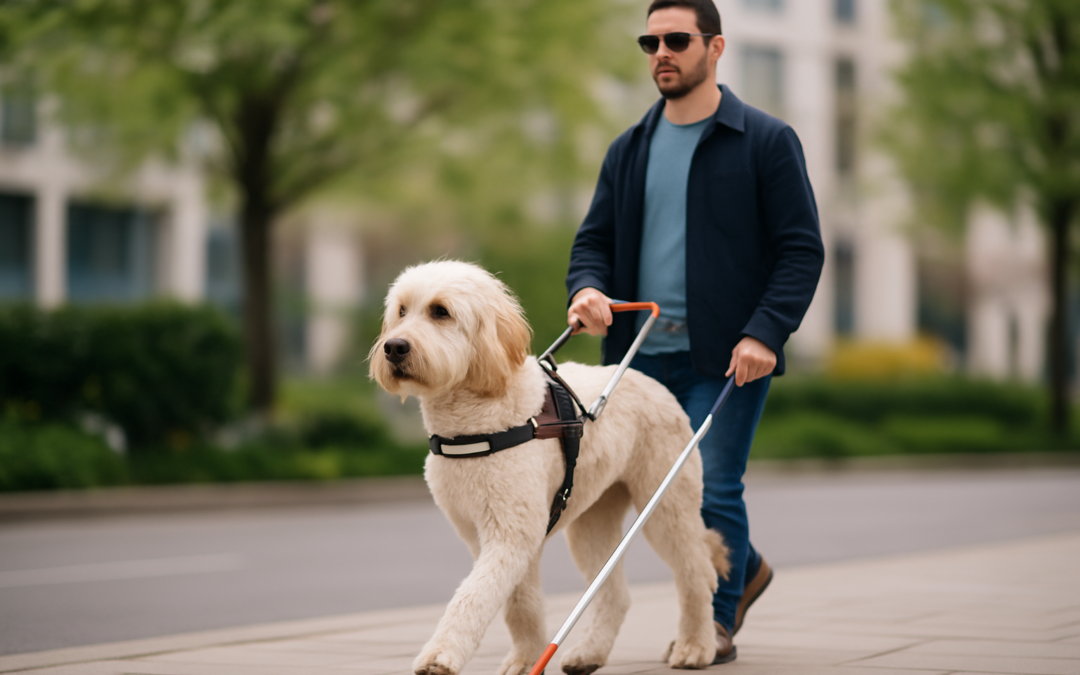
We see them every day. These silent heroines and heroes in dog bodies. They guide the blind through the hustle and bustle of the city. They assist the disabled in everyday activities that are trivial to most of us. They track down the lost in the forests, rescue people from avalanches, and compete in competitions with enthusiasm and pride. They are where we need them most.
But behind this readiness, obedience and twinkle in the eye there is something else: muscles that get tired. joints that start to creak. a psyche that needs to breathe.
Because even the most faithful dog is not a robot.
We still talk too rarely about the fact that a working dog has not only duties, but also laws. To rest. To rehabilitation. To breaks. To end a career with dignity, before the body and soul say "enough" too brutally.
This article was created to remind us of that. And to change the way we look at working dogs. Not as reliable tools. But as living beings who they give us their heart and strength – and whose duty it is to respect that.
If you love the dog you work with – read this text. To the end. And think about what you can do to make it better. Because sometimes we show the most love when… We allow the dog to just be a dog.
1. Working Dogs – Definition and Types
A working dog is not just a quadruped that knows more commands than the average person knows email passwords. It is an animal that performs repetitive, demanding tasks – often for many hours a day – with great commitment, precision and loyalty. In the human world, we call this a profession. In the world of dogs – “work mode”, which is unfortunately often mistakenly associated with something natural, not requiring regeneration.
But be careful – a dog's job is not like fetching on a walk. We are talking about specialized tasks that require both both physical and mental effort, and sometimes even inhuman (or rather un-doglike) resistance to stress, noise, fatigue or situational pressure.
Below are some examples of the most demanding "dog professions" - because that's how we should talk about them.
Guide dogs for the blind – angels watching over us 24/7
A guide dog is not just a companion – it is living GPS with empathy. Its task is to safely guide a blind person in public spaces: through busy streets, stairs, passages, elevators, shops, trams and – most difficult of all – among people who stare, ask “can I pet you?” and sometimes completely disrespect the role of the dog.
What does this mean for his body? Constant tension, walking in the guide's harness, repetitive work on one side of the body (because the dog usually walks on the same side of the blind person), thousands of micro-decisions per minute, looking up (at the person), neck twists, muscle reactions in a split second. Work does not end at the end of the walk - the guide dog is in standby mode non-stop.
Assistance dogs for people with mobility disabilities – a physiotherapist, home help and friend in one
A dog working with a person in a wheelchair will often perform tasks such as:
-
picking up dropped items,
-
opening doors with paw or muzzle,
-
pressing buttons,
-
stabilising the owner's body, e.g. when standing up,
-
pulling light loads (e.g. a cart in difficult terrain).
Doesn't sound like a relaxing weekend, does it?
These are tasks that engage very specific muscle groups. If the dog gives items from the left side every day or walks only on the left side of the cart - this happens asymmetry in the body, which over time lead to micro-injuries, degenerations and even serious injuries (spine, elbow and shoulder joints, neck).
Tracking and Rescue Dogs – The Heroes You Don't See in Action
These are dogs trained to find missing people, detect substances, search through debris after disasters or track down criminals. They work in conditions that would often break a human: darkness, noise, smells, unpredictable environments, and enormous time pressure.
Their job is marathon in sprint mode – aerobic and anaerobic effort, running, jumping, pushing, sniffing for many hours, often in difficult terrain (mud, debris, snow, heat). It is physically exhausting, but also mentally – because the dog is not only searching, but is constantly reads a man, controls the environment and must be fully focused.
Sports dogs – a dog Ferrari with the heart of an athlete
Sports dogs are often true athletes. Agility, obedience, frisbee, IPO, mondioring – these are not games, they are competitive sports. Requires strength, speed, agility, precision and reflexes.
These dogs train like competitors – often 4-5 times a week, with a competition period and a post-season. But do owners remember that every training session is micro-damage to tissues, muscle tension, risk of overload and injury? Unfortunately, not always.
What's worse, some breeds (like Border Collie or Malinois) they won't show that something hurts them, until they drop from exhaustion. Because their motivation to work is stronger than their physical limitations. And that is the greatest threat.
What do all these dogs have in common?
– They don’t work “on special occasions” – it’s their everyday life.
- Their body it is not indestructible – on the contrary, the more intense the work, the greater the risk of injury.
– Their needs are often ignored – because “he likes doing it”, “he does it himself” or “he doesn’t complain, so it’s probably OK”.
But a dog won't say: "Listen, my back hurts, give me a day off and a relaxing massage." That the guardian has the obligation to think for two.
2. The price of dog work – what happens to the body
A working dog often looks like a walking ideal: focused, efficient, with a twinkle in the eye. But behind this apparent reliability there is something hidden that cannot be seen with the naked eye: overloads, micro-injuries and tensions, which – if not properly monitored – lead to serious health problems. Because although a dog does not grumble like a person with muscle soreness, its body also has its own endurance. And anything that is constantly and one-sidedly overloaded, it will eventually burst. That's how it works.
The Most Common Injuries and Strains – A Dog is Not a Robot
Let's start with the hard data, i.e. what most often happens in working dogs:
 Muscles – eternal tension
 Muscles – eternal tension
A working dog does not have a “chill mode”. Depending on the type of task performed, chronic muscle tension can occur – especially in the neck, back, shoulder blades and forelimbs. Guide and assistance dogs often experience asymmetric voltage, because the dog works on one side of the person – the head is constantly turned, the body is slightly tilted, the muscles on one side shorten and contract.
The effect? Over time: stiffness, limited mobility, pain, and in the worst case – damage to the myofascial structures.
Joints - material consumption
The most common sufferers are:
-
elbow and shoulder joints – from constantly passing objects, climbing stairs with a load, jumping,
-
hip and knee joints – from running, changes of direction, overload in sports or tracking work,
-
Spinal joints – especially in dogs that pull carts or move on one side relative to their handler.
Add to that the breeds' genetic predisposition to dysplasia, and you get explosive cocktail ready to fire at the first opportunity.
The spine – the flashpoint of many dramas
The dog's spine, especially in the cervical and lumbar sections, is a particularly vulnerable structure. Guide dogs - turning their heads to one side most of the day - often have problems with their cervical vertebrae. In sports and rescue dogs, strains of the lower back appear - from jumping, sprinting, sudden stops.
Think about yourself: if you walked around with your head turned to the side all day and carried your backpack on only one shoulder – how would you feel in the evening?
Tendons and Ligaments – The Unsung Heroes (Until They Break)
Tendons, ligaments and fascias are subject to strain more secretly. Their degeneration is often unnoticeable… until the moment of injury. And then we have:
-
cruciate ligament ruptures,
-
tendon sheath inflammation,
-
fascial trigger points of pain.
What's worse is that dogs rarely show pain right away. Often they adapt traffic to restrictions, which makes the problem even worse.
The psyche also has its limits – a dog only gets stressed in silence
Physical stress is one thing. But a working dog constantly analyzes the environment, people, situations. He can't afford to lose concentration, because his caregiver's safety depends on his reaction. And that builds psychological tension.
Consequences?
-
Emotional fatigue.
-
Increased irritability.
-
Poorer body regeneration (because the body is constantly in “fight or flight” mode).
-
Reduced immunity.
-
Sleep disturbances – especially in dogs who “never stop being alert.”
A dog that doesn't have the space to just be... a dog becomes burnt out professionally. Yes, it's a real phenomenon – known in the world of sports and animal therapy.
Case study – a story that hurts more than an orthopedic bill
Let me share a story – not from horror, but from reality.
Bella – a Labrador, a 6-year-old guide for a blind person. For 4 years, she had been leading her owner to work every day, through the busy city center, elevators, passageways, crowded streets. Fast, agile, attentive – perfect. Except that… she never changed sides. She always worked on the left. After 3 years, she started to get slightly stiff in her shoulder blade. No one cared. After 4 years, she started to limp. Vet? “Simple strain.” Only a visit to a dog physiotherapist revealed: rotation of the cervical vertebrae, muscle tension on the left side of the body, fascia contractures, scapular displacement.
Bella underwent 3 months of rehabilitation, but her career as a guide was over. Not because she failed. Because no one had taken care of prevention before.
To sum up: a dog may not complain – but the body has one thing in common
Professional athletes have teams of physiotherapists, trainers, dietitians. Working dogs often don't even have… day off. And yet their bodies are subjected to comparable loads.
If a dog is working, it should have:
-
regeneration plan,
-
regular check-ups (not just vaccinations!),
-
variability at work (change of page, change of tasks),
-
physiotherapy,
-
time to do nothing – literally!
Because a dog is not a machine. Even if it looks like a robot that always works – every organism has its limit. And it depends only on the guardian whether this limit will be respected or brutally exceeded.
3. Regeneration and physiotherapy – a must-have, not a luxury
Work, work, work… and where is the time to relax? In the world of working dogs, the concept of “rest” is unfortunately still treated as something that “can be done, but is not necessary.” Meanwhile, regeneration is not a whim - it's an absolute necessity. And we're not talking about lying on the couch once a week, but purposeful, planned and conscious care for the dog's body, who on a daily basis performs work comparable to a professional athlete or lifeguard.
Real rest begins after work
Recovery is not about the dog “laying down”. It’s a bit like saying that a manual worker will recover by sitting in a chair after 12 hours of work. Well, no. Recovery has to be active (mobilization, stretching, balance exercises) and passive (massage, sleeping, relaxation in a peaceful environment).
Key elements of effective recovery for your working dog:
1. Regular physiotherapy – a technical check-up of the dog's body
We are not waiting for an injury, but we prevent it. A physiotherapist is not an orthopedist after the fact, but a specialist in maintaining health in movement.
What does physiotherapy provide?
-
Relaxes tense muscles.
-
Detects overloads before they become injuries.
-
Improves range of motion.
-
Teaches the caregiver how to care for the dog's body on a daily basis.
-
It has an analgesic and anti-stress effect.
How often?
For actively working dogs – at least once a month. During periods of intense training or work – even every 2 weeks.
2. Massage – because dogs deserve a SPA too
A good massage is not only a pleasure, but also a real relief for tense muscles. It can be performed by a specialist or by a caregiver who has undergone appropriate training.
Types of massage:
-
Relaxing – after work, training, stressful day.
-
Fascial – for dogs with limited mobility, chronic tension.
-
Lymphatic drainage – supporting the immune system and regeneration.
-
Sporty – before competitions or intense work.
Remember – massage is communication by touch. The dog learns to trust, relaxes mentally, and you can spot micro-tensions before they become problems.
3. Relaxation baths and hydrotherapy – not only for those who like water
Hydrotherapy is gold for muscles and joints. Dog pools are not an extravagance – they are often a key element of rehabilitation and prevention.
Benefits:
-
Relieves the joints.
-
Improves fitness without the risk of injury.
-
It allows the muscles to work without overloading the spine.
-
It works great after surgeries, but also as regeneration after an intensive period of work.
4. Proprioception exercises and stretching – dog “stretching & balance”
These are exercises that improve your dog's body awareness, strengthen the deep muscles and stabilize the joints. They don't require a gym - all you need is:
-
sensory balls,
-
Balance mats,
-
tapes,
-
platforms or rehabilitation “pillows”.
Stretching (so-called static stretching) is worth doing after work or training – gently, calmly, with control. Remember: nothing by force! This is not extreme yoga.
5. Changing the Work Side – The Holy Grail of Prevention
A dog that walks on the same side of the cart, guide or sports track every day develops asymmetrical muscle tension. And this is a simple way to:
-
scoliosis,
-
spine rotation,
-
restrictions on mobility,
-
overuse injuries.
What to do?
– Teach your dog to work on both sides.
– Change the hand that gives items.
– Introduce symmetry exercises (walking in figure eights, sideways, stepping back).
Balance is key. And literally – to health and longevity.
6. Regeneration days – dogs need weekends too
Every working dog should have days completely free from work – not only physical, but also mental. It's time for:
-
leisurely walks,
-
free sniffing,
-
sleep without interruption,
-
fun without a purpose.
Yes, exactly: zero commands, zero expectations, zero tasks. A dog needs a day when he can just be… a dog. And that’s when the body truly rebuilds.
7. Diet supporting regeneration
You can't talk about physical therapy without talking about food. Muscles, joints, ligaments - all of these need proteins, vitamins, minerals and fatty acids.
What should you add to a working dog's diet?
-
Omega-3 fatty acids (e.g. salmon oil, krill).
-
Vitamins C and E (anti-inflammatory).
-
Glucosamine and chondroitin (for joints).
-
Antioxidants (e.g. blueberries, turmeric, green tea – in appropriate doses!).
Diet is fuel. And a working dog eats like an athlete – so quality has a place here fundamental importance.
A sample recovery day for a working dog
In the morning: a quiet walk in the forest, free sniffing, no commands.
In the afternoon: a relaxing massage or physiotherapy session (20–30 minutes).
In the evening: a short session of balance exercises on a ball or cushion, stretching.
Throughout the day: lack of mental tasks, limited contact with noisy surroundings, ability to sleep in silence.
Bonus: a bath in a hydrotherapy pool or a relaxing bath with herbs (e.g. chamomile, lavender).
Summary: whoever takes care of the body takes care of the dog's life
Regeneration and physical therapy are not a reward for good work. They are part of this job. A dog that has the ability to regenerate will work:
-
longer,
-
safer,
-
with joy,
-
without pain and frustration.
And that's what it's all about, isn't it? That this loyal friend who gives his all also has the time and the conditions to get yourself together.

4. Signs of Overload – or When Your Dog Says “I’ve Had Enough”
Dogs don't complain loudly. They won't say, "Listen, my shoulder hurts and I'm tired of working today." They they send signals – subtle, but very legible for those who they want to look. The problem is that many of these signals are mistaken for disobedience, absent-mindedness, or even laziness. The result? The dog continues to work even though his body is already screaming “STOP!”
1. Change in motion – not a step like always
This is one of the first signs of overload – the dog begins to:
-
walk stiffly,
-
decelerate,
-
reluctant to climb stairs or jump into the car,
-
relieves one of the limbs,
-
when getting up, he “ponders for a moment” how to do it.
It's not a whim. It's signal from the motion systemthat something hurts, something doesn't work as it should. Sometimes it's just muscle fatigue, and sometimes it's a micro-injury that, without intervention, will become a problem for weeks.
2. Change in Behavior – A Dog You Don't Recognize
Has your dog always been keen on wearing a harness or leash? And now he suddenly backs away, turns his head away or runs away? He starts:
-
avoid eye contact,
-
lick yourself more often,
-
yawn in situations that were once routine,
-
hide or be hyper-vigilant?
These are stress signals. And stress that has no outlet and accumulates leads to mental burnout and even depression in the dog. Yes, it exists. Working dogs are often perfectionists - they won't show that they've had enough until they're really exhausted.
3. Sleep disorders and apathy - the dog does not rest
An overworked dog does not always rest effectively. It may:
-
change your sleeping place frequently,
-
have shallow sleep (wake up easily),
-
do not get on your favorite bed,
-
avoid touch, even though he loved it before.
During the day he may be "sluggish", reluctant to make contact, as if he had a sulk. But it's not a sulk - it's psychophysical overload signal.
4. Loss of motivation to work – the dog “forgets” what to do
Is he starting to ignore commands? Is he reacting sluggishly? Doesn't want to work with his favorite toy? This isn't rebellion. It could be a sign that your dog is:
-
he is physically tired – something hurts him and he cannot work comfortably,
-
he's had enough mentally – too much pressure, too little joy.
A dog is not a machine. Even the most motivated guide dog or athlete I need a reset. Lack of joy in work is not an educational problem. It is often cry for help.
5. Aggression or hyperactivity - because the dog has no way to "release" the tension
Some dogs, instead of withdrawing, begin to react with aggression or compulsive behavior:
-
growling,
-
grabbing the sleeve,
-
spinning in circles,
-
nibbling paws,
-
intensive licking (e.g. paws, belly),
-
chasing shadows, tail, light.
These are behaviors that show that the dog is overloaded and has no way to relieve himself. It's not "behavioral problems" - it's symptoms of suffering.
6. Reduced immunity – the body also says “stop”
Yes, an overworked dog will get sick more often. It can:
-
catch skin, ear, bladder infections,
-
have stomach problems (stress!),
-
lose weight despite eating,
-
his hair is falling out more than usual.
The immune system does not function at full capacity when the body is constantly stressed and tired. The body cries for help – only quietly.
7. Increased “strange” behavior – the dog seeks relief
The dog may begin to:
-
bite objects obsessively (even though he had never destroyed anything before),
-
dig holes,
-
going for walks or… not wanting to come back from them,
-
demand your attention by barking, squealing, jumping.
These can all be mechanisms for coping with stress and overload. Like a person who starts cleaning compulsively or snacking on cookies out of nervousness.
How to react when you suspect overload?
Step 1: Let go.
Give your dog a break. At least 2–3 days of complete relaxation: no work, no training, plenty of sleep and leisurely walks.
Step 2: Observe.
Is the behavior returning to normal? Does the dog seem more relaxed?
Step 3: Consult a physical therapist or veterinarian.
If something in the movement doesn't feel right - act immediately. Don't wait for an injury. Prevention is cheaper and less painful than treatment.
Step 4: Change your plan.
Don't go back to the same routine. Change the frequency of work, add recovery days, rethink your dog's motivation. And remember - a dog is a partner, not a tool.
Summary: Listen before your dog screams
Overload doesn't come overnight. It's a process - quiet, slow, insidious. But very clear if you look carefully. Every dog has its own limit of endurance - physical and mental.
Your duty as a guardian is to know it and protect it.

5. Regeneration – or the dog also needs a weekend (and a massage)
A working dog is not an automaton that you turn on and off with a switch. It is a living being that, just like us – gets tired, bored, overworked, and even burns out professionally. Even the most motivated guide dog, therapist or athlete has your limits. And they must be respected.
Proper regeneration is it's not a luxury, it's a necessity. Without it, the dog will not be able to work effectively or for long. And we are talking about both physical and mental regeneration.
Mental regeneration – not only the body rests
 Mental regeneration – not only the body rests
A dog that has to be focused, composed, and work in difficult conditions every day carries a huge emotional burden. In the case of dogs:
-
guides for blind people,
-
assisting with wheelchairs,
-
taking part in dog therapy,
-
working in tracking or rescue,
we are talking about constant pressure. Every "failure" can affect his sense of security. Therefore:
-
Minimum 2 full days per week – without work. Total reset: walks, play, petting. No commands, no harnesses, no "I have to do something right."
-
Varied activities. A dog cannot be just “on the job”. It needs a leisurely walk, sniffing, rolling in the grass, tugging with a tug – for yourself, not for the caregiver.
Physical regeneration – not just sleeping, but also stretching
 Physical regeneration – not just sleeping, but also stretching
This is where we enter the professional level. A dog that uses the same muscles, joints and tendons every day, must have relief and compensation. And no, a “Sunday walk” won’t cut it.
Things to remember:
-
Daily warm-up and cool-down. 5 minutes of easy movement before and after work – like an athlete. You don’t throw your dog into a track or obstacle course right away. He needs to warm up and then loosen up.
-
Muscle massaging – you don't have to be a physiotherapist. Even a gentle massage of the back, shoulder blades, neck or thighs after work increases blood circulation, reduces tension and accelerates regeneration.
-
Stretching – gentle, conscious joint movements (with the help of a specialist or after training) are a great way to prevent injuries.
-
Physiotherapy and hydrotherapy – once every 1–2 weeks at an animal physiotherapist (not only when something breaks!). Well-managed rehabilitation relieves overloaded areas and activates neglected ones.
Sample weekly schedule for a working dog (e.g. guide dog)
 Sample weekly schedule for a working dog (e.g. guide dog)
| Day of the week | Activity | Regeneration |
|---|---|---|
| Monday | 3 hours of work + 2 short walks | Evening massage, stretching |
| Tuesday | 2 hours of work + 1 hour of training | A quiet walk in the field, relaxation in the garden |
| Wednesday | Day off | A leisurely walk + playing, sleeping, sniffing |
| Thursday | 3 hours of work | After work, bath, stretching, treats for the olfactory mat |
| Friday | 1 hour of work + 2 hours of training | Physiotherapy/Hydrotherapy |
| Saturday | 2 hours of light work (shopping, walking) | Walking on a long rope, rolling in the grass |
| Sunday | Day off | Field trip, playing with another dog, emotional reset |
Of course - it's just an example. We adapt the plan to:
-
age,
-
races,
-
condition,
-
type of work,
-
psychological predispositions of the dog.
But the pattern is clear: there must be balance.
What to avoid?
 What to avoid?
-
Working 7 days a week without a break (even if it's "just a walk around the neighborhood" - the dog is always there He's working).
-
Ignoring changes in movement and behavior.
-
Thinking that massage is a whim (“the dog will stretch itself” – yeah, right).
-
Expectations of perfection every day (“he likes it” ≠ “he has no right to be tired”).
Summary: A working dog is an athlete with his heart on his sleeve.
 Summary: A working dog is an athlete with his heart on his sleeve.
If you want your dog to support you for years to come, he needs to have a recovery plan. Regular. Consistent. And tailored to his needs.
Just as an athlete has a diet, a trainer, a masseur and days off, a dog should have:
-
days without work,
-
help of a physiotherapist,
-
daily care routine,
-
plenty of sleep and mental relaxation.
Because a dog that has the strength to return to work with joy is a dog that is truly well cared for.
6. Physiotherapy, massage, stretching – practical techniques for dogs in the profession
You don't have to be an animal physiotherapist to provide your dog with daily overload prevention. But it's worth understanding what to do, when, how and why. Thanks to this, you will avoid not only injuries, but also a drop in efficiency and motivation. And the dog will gain something invaluable - comfort of life.
What does physiotherapy do for a working dog?
 What does physiotherapy do for a working dog?
Physiotherapy is not just about “treating injuries.” It is:
-
preventing overloads and injuries,
-
improving muscle flexibility and range of motion,
-
supporting regeneration after intense exercise,
-
detecting micro-problems before they become major problems.
Well-managed physiotherapy keeps the dog in shape, balances the load (because, for example, a guide dog always walks on one side of the wheelchair!), and extends his career by several years.
Massage – gold for muscles and psyche
 Massage – gold for muscles and psyche
Regular massage:
-
improves blood and lymph circulation,
-
relaxes tense muscle groups,
-
helps in removing metabolites after exercise (e.g. lactic acid),
-
has a calming effect and builds the dog-human bond.
A simple massage you can do yourself:
 A simple massage you can do yourself:
-
Wait until your dog lies down and relaxes.
-
Stroke the back slowly, from the neck to the tail. Keep your hands in contact with your body – do not remove your hands.
-
Using circular motions, massage the shoulder blades, thighs, and neck. Don't press too hard - this is not a Thai massage.
-
Observe your dog's reactions. When you see licking, yawning, blinking – you are on the right track.
 Attention: If the dog avoids touching a specific part of the body or reacts nervously – it is a sign that something may hurt there. Then it is worth going to a professional. And have you ever heard of a massage based on the “Shantala” or “T-Touch” technique? I encourage you to read the literature:)
Stretching – stretching that makes sense
 Stretching – stretching that makes sense
Stretching is not just about the “dog yawns and stretches” position. It is a specific technique that supports joint mobility and muscle flexibility.
What can be stretched for a dog:
-
front paws (stretching arms and chest),
-
hind limbs (hip muscles, thighs),
-
spine (gentle torso twists),
-
nape and neck (gentle head tilts to the left/right).
Stretching is best done:
-
after work, never before (the muscles must be warmed up),
-
take it easy, in the form of play or while petting,
-
gently, without coercion – the dog must want to cooperate.
If you don’t feel confident – ask your physiotherapist to teach you some movements to use every day.
Hydrotherapy – the queen of regeneration
 Hydrotherapy – the queen of regeneration
Hydrotherapy (dog pool or water treadmill) is a hit:
-
minimal load on joints,
-
maximum muscle engagement,
-
great for burning energy and building fitness.
For the working dog, this is an ideal way to:
-
relaxation after a week of work,
-
restoration of movement symmetry (e.g. after unilateral work),
-
rehabilitation of minor injuries.
For older dogs – this is also a way to maintain fitness without the risk of overload.
When and how to use professional physiotherapy?
 When and how to use professional physiotherapy?
Minimum once every 4–6 weeks A working dog should be seen by an animal physiotherapist. It is worth it more often if:
-
the dog has an asymmetric way of working (e.g. always walks on one side),
-
he has been injured in the past,
-
has difficulty stretching, jumping up and down stairs,
-
begins to lose motivation to work or likes to rest “too much.”
After any intense physical work (e.g. competitions, tracking, rescue operations) the dog deserves regeneration. Not another day of work “because that’s how it turned out.”
It is worth investing in:
 It is worth investing in:
-
sensorimotor mats (for balance exercises),
-
massage balls and hedgehogs,
-
cooling mats (in summer, after exercise),
-
natural oils (e.g. lavender) for relaxing massages,
-
regular sessions with a trusted physiotherapist.
Summary: A dog is not a machine – its body is capital
 Summary: A dog is not a machine – its body is capital
A dog that works is a dog that uses up his body. Just like an athlete. The difference? An athlete has a whole team of people to take care of them. A dog has you. And only you.
Massage, stretching, physiotherapy and hydrotherapy are not luxury, but smart care.
Thanks to them:
-
the dog lives longer and healthier,
-
you avoid costly injuries,
-
dog I want to work and does not lose motivation.
7. Dog burnout – a taboo topic that needs to be finally dispelled
We think of the working dog as a hero. Always ready, always in shape, always focused. But the truth is, even the most committed, devoted dog has limits to mental endurance. If you exceed them – instead of a co-worker, you have a stressed, withdrawn dog that increasingly “fades out”.
And no, that's it doesn't meanthat your dog is "spoiled", "has a temper" or "is lazy". It means that his psyche says STOP.
What is dog burnout?
 What is dog burnout?
It is a state of chronic mental and physical fatigue resulting from:
-
lack of balance between work and rest,
-
too much pressure (often unconsciously exerted by the caregiver),
-
boredom and routine,
-
lack of internal motivation,
-
unrecognized painful symptoms that reduce the quality of life.
Effect? A dog stops “wanting.” And then he stops “being able to.”
Symptoms of burnout in dogs – don’t ignore these signs:
 Symptoms of burnout in dogs – don’t ignore these signs:
-
decreased motivation to work (the dog no longer enjoys tasks it once loved),
-
resistance to putting on a harness/collar/going on duty,
-
increased irritability or withdrawal,
-
excessive sleepiness or anxiety,
-
losing previously learned skills,
-
lack of interest in playing or eating,
-
stress reactions to previously known situations (e.g. sounds, places, people).
 Burnout is most often confused with dog “rebellion” or laziness. But this is a cry for help.
Why do dogs burn out?
-
Because they are too good. Working dogs are often overlearned, overloaded and too eager to cooperate. And no one notices that they can't cope.
-
Because they have no right to NO. A dog can't say "I don't want to today." But he should be able to. At least sometimes.
-
Because people project their ambitions onto the dog. “My dog can do it, he needs to practice more, he needs to do it better.” Sound familiar?
-
Because there is no balance. Only work, work, work. No free walks, no freedom, no silliness, no rolling in the grass. A dog is not a machine.
What to do when you see signs of burnout?
 What to do when you see signs of burnout?
 Stop.
 Stop.
Stop.Take a week off. No work. No pressure. Just rest, play, sniff, sleep. Watch the dog.
Sometimes this is enough to bring back the joy.
Change scheme.
The daily routine of a working dog can be deadly monotonous. Try:
-
introduce new activities (nosework, mantrailing, free walks in new areas),
-
change the time of day at work,
-
change the method of rewarding (new toys, different treats, form of reward),
-
allow your dog to make more choices (e.g. decide which route the walk will take).
Take care of your body.
The decrease in willingness to work is often due to pain or discomfort. Physiotherapy, examination by an orthopedist or osteopath, massage - this can work wonders.
Review your relationships.
Does your dog feel safe with you? Are you demanding too much? Is there a partnership between you or are you just “giving orders”?
Sometimes it's worth going back to basics and rebuilding trust.
Can a dog return to work after burnout?
 Can a dog return to work after burnout?
Yes. But on condition that:
-
will have reduced working hours,
-
will receive greater support and internal motivation (fun, relationship, diversity),
-
will be regular rest and have time for yourself.
Not every dog recovers to full health. And that's OK too. Maybe instead of working 6 days a week, he will work 2. And enjoy life.
Summary: Burnout is not a myth. It's a real threat.
If you love your dog, if you care about his well-being, you need to notice the signals. Because a dog won't say, "I can't do this anymore."
He will show it. Your job is to notice. And react.
Burnout is treatable. But best of all – to prevent. Giving your dog:
-
a reasonable amount of work,
-
days off,
-
diversity,
-
emotional support,
-
and the right to just be a dog.
8. When to Say Enough – Working Dog Retirement
A dog won't tell you directly, "I don't want it anymore." But his body and behavior will send signals. Your role - as a caregiver, guide, partner - is to notice them and don't ignore them.
Because keeping a dog at work “by force” is nothing more than slowly taking away its quality of life.
Why is it so difficult?
 Why is it so difficult?
-
Because a working dog is often “part of the team”, a work tool, an everyday companion.
-
Because you feel that the dog is a "tough guy" and that he can handle it.
-
Because you are afraid that without work the dog will "waste" - or that you won't be able to cope without it.
But the truth is: every dog deserves a dignified end to his career. Not when he can't get up anymore. Only when it still can – but it doesn’t have to.
Signs it's time to retire:
 Signs it's time to retire:
-
Decrease in physical performance – the dog gets tired faster, takes longer to recover, and limps more often.
-
Micro-injuries or chronic pain – appear despite prevention.
-
Changed movement dynamics – the dog works slower, with less freedom of movement.
-
Cognitive disorders – the dog “gets lost” in routine tasks and seems distracted.
-
Decrease in enthusiasm for work – lack of desire, less motivation, withdrawal.
-
Behavioral changes – irritability, anxiety, over-excitement or apathy.
Attention: in working dogs these signals can be subtle – because many of them “hide” their tiredness so as not to disappoint their humans.
How do you decide to end your dog’s employment?
 How do you decide to end your dog’s employment?
It doesn't have to be a sudden change. Sometimes it's better to:
-
gradually reduce the number of working hours,
-
give up the most burdensome tasks,
-
introduce “days off” and regeneration periods,
-
until finally…retiring completely.
It is good if the decision is made:
-
in consultation with a veterinarian/physiotherapist,
-
with respect for the real capabilities of the dog,
-
before serious health problems occur.
Retired Dog – Now What?
Don't "put away" your dog like a used toy. Retirement is not a death sentence – it is a new phase of life. And it can be beautiful if you give it:
-
time and space – for quiet walks, rolling in the grass, sniffing aimlessly,
-
social contact – the dog still wants to be part of the family, he still needs you,
-
classes adapted to your abilities – nosework, tugging while lying down, simple olfactory games,
-
medical and physiotherapy support – a retiree also needs massage and supplements.
If the dog was your "work tool" - now let him just be a dog. And let him know that he is still needed. Just differently.
What if I need to pass on the dog?
 What if I need to pass on the dog?
It happens that a working dog goes into retirement, but he can't stay with his guide – e.g. for organizational, financial, health reasons.
Then:
-
look for a home that knows the realities of living with a working dog,
-
tell the truth about his health and needs,
-
ensure a smooth transition – transfer the dog to the caregiver gradually, with adaptation.
It's hard. But if you can't provide your dog with a good retirement - do everything you can to make sure he ends up where he can get one. This is also a responsibility.
Summary: Retirement is not the end. It's a reward.
A dog that served people, supported, saved, guided, tracked – deserves to rest with dignity. With a soft bed, peaceful days, Your presence.
Don't wait for your body to break down. Don't force it to give its last strength.
He deserved it.

Sources:
1. Organizations dealing with dog welfare and work ethics:
-
The International Association of Canine Professionals (IACP)
Website: www.dogprofessionals.com
IACP is an organization that promotes ethical methods of working with dogs and their welfare. Here you will find many materials regarding the work of dogs, both as employees and service animals. -
American Veterinary Medical Association (AVMA)
Website: www.avma.org
The AVMA is an organization that provides numerous studies and guidelines on the care of dogs, including working dogs. Their materials can support the health and rehabilitation of dogs. -
Assistance Dogs International (ADI)
Website: www.assistancedogsinternational. org
An organization dedicated to training assistance dogs, dedicated to promoting the welfare of working dogs. ADI develops guidelines for dogs' work and rest.
2. Scientific research and articles on the work of dogs:
-
“Working Dogs: Physiology, Training, and Health Considerations” -scientific article
This article discusses various aspects of working dogs, including their physiology, health, and rest and rehabilitation needs. There is a wealth of research on the health of working dogs that is worth using as a basis for the article. -
“Canine Fitness: Assessing the Health and Wellness of Dogs in Working Roles” - test
A study on the physiology of working dogs that highlights the need to care for the physical condition of dogs in the context of their intensive work. It may be helpful in describing the importance of rehabilitation and rest. -
“The Impact of Overworking on Working Dogs” - publication
Work on overwork in dogs, including the impact of stress and overactivity on the physical and mental health of dogs. This research highlights the importance of burnout prevention and regular rest for working dogs.
3. Guides and books on dog work:
-
“Working Dogs: A Complete Guide to Working with Dogs” - a book by Maria Fenwick
The book provides practical information on working dogs, their health, training methods, and tips on resting and recovering them. Fenwick also discusses how to recognize when a dog is ready to retire. -
“Canine Rehabilitation and Physical Therapy” – book by Darryl Millis and David Levine
A book that offers detailed information on dog rehabilitation, including physiotherapy and massage techniques that help dogs work as well as recover after intense exercise.
4. Quotes and veterinary materials:
-
The Royal Veterinary College (RVC)
Website: www.rvc.ac.uk
RVC provides up-to-date information on veterinary care for dogs, including working dogs. This can be a valuable resource for service dog medicine and rehabilitation. -
“The Rehabilitation of the Working Dog” – study authored by specialists in veterinary medicine and dog rehabilitation.
This article discusses rehabilitation programs for working dogs, pointing out the importance of rest and adapting the level of physical activity to the needs of the animals.
5. Websites dedicated to service dogs and their work ethic:
-
Guide Dogs for the Blind
Website: www.guidedogs.org
This organization provides information about guide dogs and their care, rehabilitation, and retirement requirements. It is a great resource for questions about guide dogs. -
International Search and Rescue Dog Organization (IRO)
Website: www.iro-dogs.org
IRO offers information on rescue dogs and their specialized training, health and rest. It includes guidelines for the care of dogs that work in extreme conditions.
6. Articles on Dog Work Ethics:
-
“Ethical Issues in Working Dogs: A Call for Change” – article published in the Journal of Animal Ethics
This article discusses the ethical challenges associated with the work of dogs and the need to consider their welfare in the context of the professions they perform.
7. Documentary films and educational programmes:
-
“Dogs: The Work of Heroes” (Netflix)
A documentary that looks at the lives of working dogs, from uniformed services to assistance dogs. An ideal source for illustrating their role and the challenges they face. -
“The Truth About Working Dogs” (BBC)
A documentary showing what the lives of working dogs are like, how to work with them and how to provide them with proper care.
The author of the text is Edyta Gajewska. Copying, processing, distribution of these materials in whole or in part without the author's consent is prohibited.


