
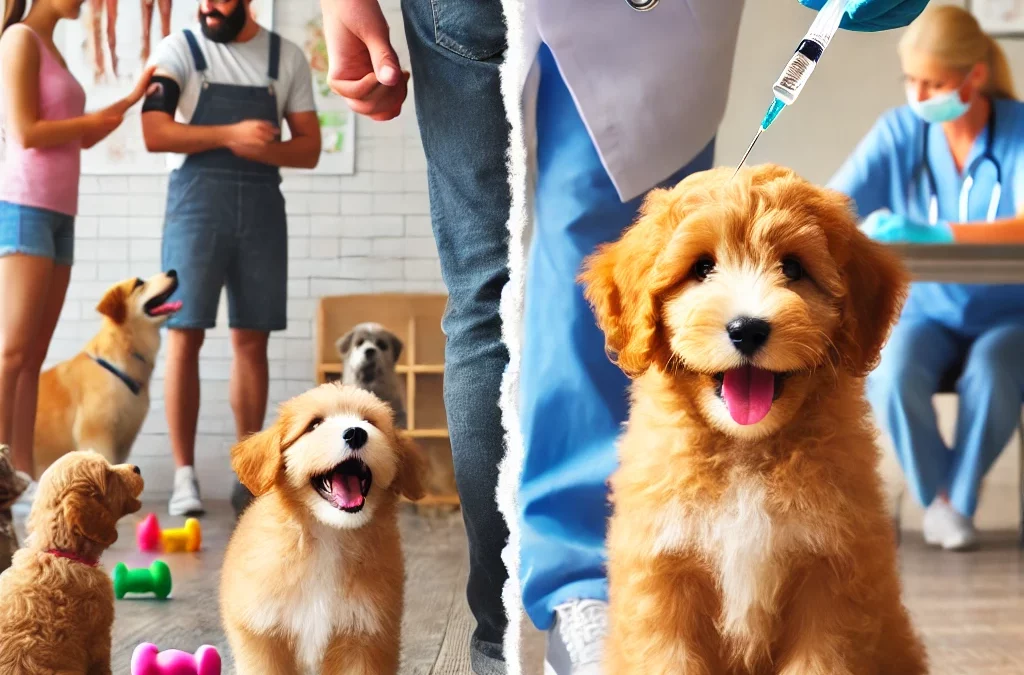
According to American Veterinary Society of Animal Behavior Behavioral problems, not disease, are the most common reason dogs are abandoned in shelters.
Puppy Training – When to Start and Why is It So Important?
Every time I hear these words, I feel sad and frustrated. Not because the owners want their dog to be bad – quite the opposite! They were simply given the wrong information that could affect the dog's entire life.
When is the best time to start training a puppy?
As soon as you welcome a new puppy into your home, you naturally want the best for it. So you listen to the breeder, vet, and pet store clerk. The problem is that many of these people are giving you outdated or even harmful information.
The most common piece of advice you hear is, “Don’t take your dog out until they’ve had all their vaccinations.” Sounds reasonable? Unfortunately, it’s a myth that could harm your pet more than the potential risk of illness.
The Critical Window of Socialization – The Key to a Healthy Dog Psychology
Puppies have a limited time in which their experiences shape their adult lives. This is called critical period of socialization, which lasts from about 3 to a maximum of 14 weeks of age. During this time, the puppy learns what is safe and what to be afraid of. If during this period the puppy does not get to know different people, places, sounds and situations, it may grow into a fearful or aggressive dog.
Puppy development stages:
- Week 3–5 – Primary Socialization – The puppy begins to perceive its surroundings and learns to interact with its siblings.
- Week 6–12 – Secondary Socialization – The most important period of adaptation to the human world. The puppy should experience different situations, places and people.
- about 7–8 weeks – The moment when the mother starts correcting the puppies, teaching them self-control. This is also the optimal time to move to a new home.

What happens when you wait too long?
Starting socialization too late can lead to serious behavioral problems, such as:
- Separation anxiety,
- Fear of new situations,
- Aggression towards people and dogs.

How to ensure good socialization?
- see different places – city, bus stop, traffic, children playing in the playground, other animals, for example, I use the moments when I go to football training with my son, I always take the puppy – we sit calmly and get used to different stimuli (without interacting with people), I also often stop at petrol stations, or in the parking lot near the shopping centre, and many, many other ideas that I share with you during conversations and in the videos that I send to you – waiting to pick up your little one.
- have interactions with people and other dogs – of course, in controlled conditions, which I talk about in webinars. And in an appropriate way (VERY IMPORTANT!), which I also talk about widely and pay a lot of attention to, few of us know that interaction with people must be appropriate for a puppy. What does this mean? Strangers, often unknowingly approaching our puppy, unknowingly send a lot of threatening signals – they approach straight ahead, stare at our dog and often in the eyes, bend over him, reach out and stroke his head and often smile (in dog language, what does it mean when another dog “bares its teeth”?) These are as many as 7 threatening signals. So does our dog have a chance to learn that people are cool? This is a very important topic for me and learning how to interact appropriately with strangers is aspect number one for me. Knowing my puppies, I describe the method of socialization for each of them adequately. Yes, it is never standard, because each puppy is different. One may end up withdrawing from people in an incomprehensible way, while the other may react to the same person and the same approach with excessive excitement. But this is just the way he reacts to an uncomfortable situation. Only you can see from the dog that withdraws that he does not like it. And a puppy that jumps at a newly met person, runs in circles, bites the leash - does not arouse our concern anymore. And it should, because in this way the dog presents the so-called "flirting behavior", i.e. pretends to be stupid. Unfortunately, both puppies will have behavioral problems in the future related to improper socialization ... and they showed it already when they were young puppies - and this is the time when they should be taught that people are safe. I will not write here because this topic is as broad and deep as the ocean for me. However, webinars and educational films on the socialization of specific litters thoroughly break down the topic into prime factors.
- be focused on different stimuli – sounds, surfaces, moving objects.
- have fun solving problems, overcoming obstacles that stand in his way – these help build the dog’s self-confidence.


