
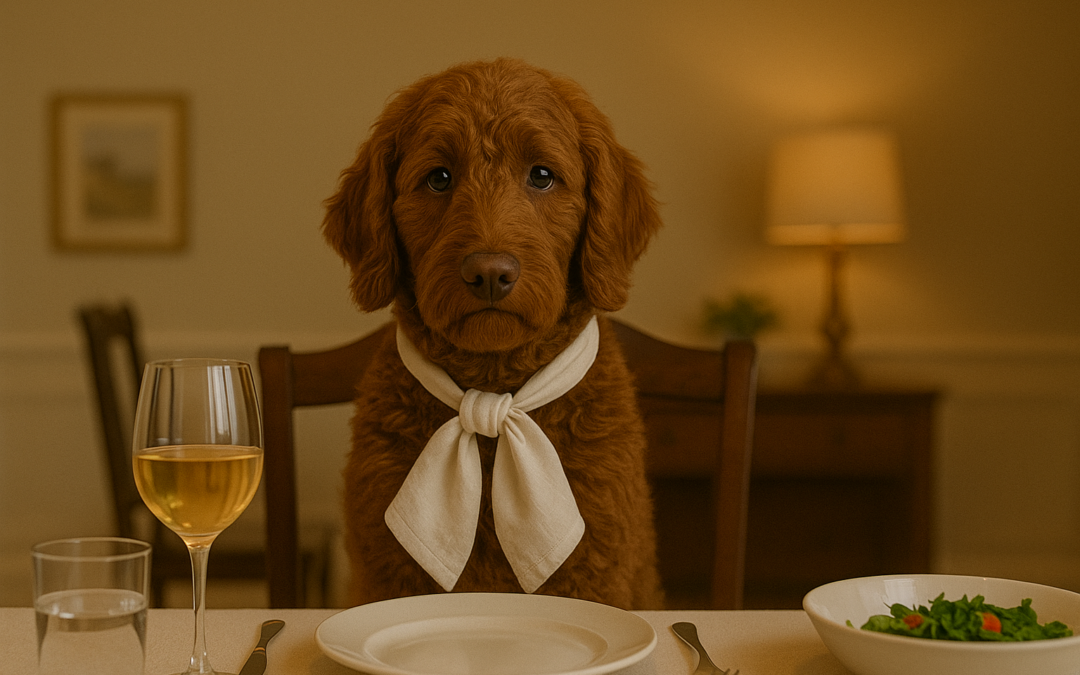
A dog is not a small person, but…
Imagine: a tiny puppy with round eyes and soft ears arrives at a new home. The household members fall in love at first sight. They react to every sound, every movement, every look. "He loves me!", "She's jealous of the cat", "He did it on purpose because he was offended". You know that, right?
There is nothing wrong with loving our dogs. They truly become part of the family, confidants of emotions, everyday companions. But in this love it is very easy to cross the thin line and start to attribute human traits, emotions and motivations to them. And this is where the problems begin.
Personification of dogs, especially puppies, is a trap. Instead of understanding their real needs and signals, we begin to interpret their behavior through the filter of our human experiences. And what may mean “anger” or “jealousy” to a human, may simply mean stress, insecurity, or an inability to cope with the situation to a dog. Instead of helping, we begin to harm.
But be careful – let’s not throw the baby out with the bathwater (or the puppy out of the carrier). Although a dog is not a human, the development of a puppy really does have a lot in common with the development of a small child. And it’s worth stopping here. Not to continue playing around with dressing the dog in a onesie and putting him on a “stool”, but to extract from raising children what really works: a sense of security, building self-confidence, supporting independence, the calm presence of an adult.
Today I wanted to address the myths about dog emotions and show why personification is dangerous – even when it comes from love. But I will also look at puppy development through the prism of good practices known from raising children. Because although a dog is not a child, it deserves to be raised with tenderness, empathy and wise guidance.
What is personification and why is it harmful to dogs?
Common Examples of Personification – and What's Really Behind Them
1. "“She got offended.”
Dog does not come when called, turns back after being scolded. Looks like a "proud princess with a sulk."
Reality: A dog may avoid contact because he reads our tone of voice, body posture, tension—and feels the tension, and perhaps the fear. This is a calming strategy, not emotional revenge. We perceive it as “pompousness,” and the dog is simply trying to avoid conflict.
2. "He did it out of spite."
Dog peed on carpet right after we left home. Ate shoe. Ruined pillow.
3"He wanted to show me!"
Reality: Dogs don't plan revenge. Their behavior is driven by emotions – separation stress, boredom, frustration. They act "here and now", they don't plot. And if they destroy the house when we're not there, they're shouting, "I can't handle it! Help me, don't punish me!"
4 "He knows he did wrong - look at how he looks."
A dog with its head down, tail between its legs, and a “guilty” look after it has done something wrong.
Reality: A dog does not feel guilt in the way we perceive it. He reads our emotions—tone of voice, facial expressions—and adopts a calming posture that is intended to avoid conflict. This is not an admission of guilt, but an attempt at de-escalation.

Why is it harmful to the dog?
Personification isn't just harmless chatter to your pet. It can lead to:
1. Misinterpretation of the dog's emotions and needs
If you think your dog is offended, you may ignore his real signs of stress. If you think he is jealous, you may overlook the fact that he needs space or clearer boundaries.
2. Inappropriate reactions of the caregiver
Instead of supporting your dog in a difficult situation, you start to scold him, take offense, or treat him like a spoiled child. And the dog… gets more and more lost.
3. Reinforcing undesirable behaviors
If you think that the dog is doing something "out of spite" and you react emotionally - you can unconsciously reward its behavior with attention. Or worse - punish it not at the moment of the "crime", but after some time, which the dog will perceive as completely incomprehensible.
4. Human-dog relationship disorders
A relationship based on misunderstanding is neither safe nor stable. The dog cannot be itself, because it is constantly drawn into the theater of human projections. And the owner, in turn, feels cheated or manipulated by… a dog who simply does not understand the script.
What Dog Emotions Really Are – and What They Aren't
Dogs feel. That's a fact. They have basic emotions - joy, fear, frustration, curiosity, sadness, contentment, excitement. But they don't have complex emotions that require self-awareness and moral judgment - such as envy, guilt, hatred, or irony.
That's why it's not worth trying to "figure out" your dog as if he were a character from a soap opera. Instead, learn his language:
- Yawning, turning away the head, licking the nose – calming signals, not “boredom”.
- Growling is a form of communication, not “malicious aggression.”
- Peeing in the house – a possible sign of stress, not “revenge”.
- Failure to respond to command – distraction, misunderstanding, or emotional overload, not “teenager rebellion.”


Puppy Development vs Child Development – Where Are the Similarities?
We don’t have to treat a dog like a child to see that… puppy development resembles child development. And not metaphorically, but very realistically — at the level of neurobiology, emotions, and social needs.
This does not mean that a dog is a “fur baby”. It means that the process of shaping its personality, sense of security and life skills has many points in common with the development of a human child. And if we approach it wisely – we can raise a dog that will be stable, resistant to stress and self-confident.
The need for security – the basis of every development
Both a puppy and a child will not develop healthily if they do not feel safe. The need for safety is fundamental - without it there is no curiosity, learning, play or relationship.
In puppies, as in children, the relationship with the caregiver acts as a base – a point of reference. The dog “borrows” courage from you. If it knows that you are there, calm, predictable and supportive, it explores the world with curiosity. If it does not know what to expect from you, it shuts down, reacts with fear or aggression, because it has no other way to deal with anxiety.
Sound familiar? Children function in exactly the same way. Child psychology talks about attachment styles — and dogs, yes, also form an attachment bond with their caregiver. And their emotional development depends on the quality of that bond.
Explore, play and learn – but only when it's safe
Children and puppies learn through exploration. They need to see, touch, smell, try, make mistakes, and learn from them. This doesn’t work when they’re stressed, overstimulated, or punished for every time they cross a boundary.
Similarity #1: Both a puppy and a child need space to explore – but also framework and guidance.
We don't leave a child in the forest to "raise itself", do we? But we also don't take every stick out of its hands. The same with a dog - it's not about stress-free upbringing ("do whatever you want"), but about the wise presence of an adult who shows what is safe and what is not.
Developmental phases and "crises" - in children and dogs
Both children and dogs go through sensitive periods and developmental crises that affect their behavior.
In puppies we have, among others:
- Socialization period (3–12/14 weeks) – a key time when a puppy learns what the world is: people, sounds, dogs, smells, objects. What he experiences then stays with him for a long time.
- Anxiety phase (approx. 8–10 weeks, then another one approx. 8 months) – a period in which new stimuli can trigger a strong anxiety reaction. Even things that were previously familiar.
- Adolescence (approx. 6–18 months) – a hormonal hurricane and a test of strength. The dog tests boundaries, becomes more independent, and often “forgets” to learn.
Sounds like teenage rebellion? No wonder. This is also where the last period of anxiety can appear.
In children:
- We have analogous "developmental leaps", so-called "rebellious phases" (2-year-old, 4-year-old, teenager), alternating periods of dependency and independence, separation anxiety, hormonal storms.
The key in both cases? React with calm, consistency and understanding, rather than taking everything personally.
Developing independence – not replacing, but supporting
A child learning to walk will fall over. And that's good. If you hold their hand all the time, they won't learn independence. If you scold them or do the job for them every time they fall over, you'll develop a fear of failure.
It's the same with a dog. Your job isn't to "protect your dog from the world," but to prepare him for life in that world.
That is: let him solve problems, support him in difficult moments, but don't put a mat under him every time he faces a challenge.
Good parenting is not about removing obstacles, but learning to overcome them.
Language that builds self-confidence
You tell your child: "You can do it, you're brave."
You don't tell your dog this in words (although you can, because tone works too), but you can express it with your attitude and behavior:
- you don't panic when the dog gets scared of something - you just stand there, calmly, you are the "anchor", you can even recite a poem in a calm voice.
- you don't take over every social situation for him - you let him meet new dogs, explore new places, and you don't hide him behind you,
- You don't punish for emotions - but you show how they can be expressed differently.
Puppy and child development share several key needs:
- Security as a foundation,
- Explore and learn in a supportive atmosphere,
- The ability to make mistakes and learn from them,
- The need for a relationship with a caregiver as an emotional base,
- Development crises that require understanding, not panic.
This does not mean that a dog is a child. It means that we can raise a dog the way we raise children wisely – not by humanizing it, but by supporting its developmental, emotional and social needs.
Sensitivity, predictability, autonomy – what can we “borrow” from raising children?
Just because a dog is not a human being does not mean that we cannot be inspired by wise child-rearing. Because upbringing based on empathy, a sense of security and supporting independence… works regardless of species.
It's not about treating your dog like a child. It's about being the kind of guide you would want to be for your own child: calm, present, predictable, and patient.
Here are three pillars worth taking from “human” upbringing to the world of dogs.
1. Tenderness – i.e. contact and understanding, not pampering
Tenderness is not the same as pampering. It is attentive presence, readiness to support and emotional availability. In the world of children, it is the foundation of healthy attachment. In the world of dogs – exactly the same.
- A dog needs your presence – not just physically, but emotionally. It’s not enough to be “next to” – you have to be “for”.
- Petting, cuddling, a calm tone of voice – all this helps the dog feel safe as long as its right to refuse is respected.
- Reading your dog's emotions and responding to them – this is the tenderness that builds trust.
Affection isn’t about giving your dog everything he wants. It’s about giving him what he really needs – even if he doesn’t always like it (e.g. boundaries, rest, training instead of chaos).
2. Predictability – because safety comes from routine
Children love rituals – the same bedtime songs, the same stories, the same daily routines. This gives them a framework in which they feel safe.
Puppies are no different. They love repetition because it helps them understand the world.
- Fixed times for walks, feeding, and sleeping – this is not a whim, it is a therapeutic tool for the dog's nervous system.
- Clear rules – e.g. where you are allowed to go, what you are allowed to bite, when you start playing – build a sense of stability.
- Predictability in the emotions of the owner – this is very important. The dog does not understand your words, but it feels your mood perfectly. If you react with laughter and screaming one time – it does not know where it stands.
Predictable guardian = safe world = calm dog. Just like with a child.
3. Autonomy – because everyone must have a chance to “get by”
Good parenting is not about control. Neither children nor dogs can be raised “by remote control”. Instead, they can be given space to develop their own competences.
In children:
- we allow you to dress yourself, even though it takes ages,
- we teach them that they can say "no" - because it builds their boundaries,
- We support attempts to solve problems instead of always providing ready-made solutions.
In dogs:
- let your dog explore on his own (in safe conditions, of course),
- don’t interrupt when he’s trying to figure out how to get to the treat in the toy – even if it takes a long time,
- Give him the right to refuse contact – if he pulls away, don’t push.
All this builds the dog's sense of agency and control over its own world, which is the foundation of mental resilience.
“You can do it” – a magic phrase that works on dogs too
The point, of course, is not to say it to your dog (although you can – tone and energy matter), but to carry that sentence in your head when you are with him.
- When a dog is afraid of a new sound, do not take it away immediately, but stay calm around it. Do not reinforce the fear with your reaction.
- If he doesn’t know how to get over an obstacle – don’t lift him up right away, just give him time.
- When something isn’t working out for him – encourage him, don’t do it for him.
It's exactly the same principle as in raising children: don't do the job, don't shame, don't criticize - support.
Some practical rules from “human” training that work great with dogs:
- 5 to 1 rule – for every correction, give your dog five positive reinforcements (praise, treat, smile, contact, play).
- The first impression rule – what a dog (or child) associates with a given place/person/thing the first time, stays in memory. That is why first experiences must be positive and calm.
- The rule of "one message - one meaning" - do not say "get down", "get lost", "come on", because the dog (like a child) does not understand nuances. Teach clear messages.
- The principle of self-regulation – do not expect your dog to be self-controlled if you have not created the conditions for him to learn it (e.g. breaks, sleep, quiet time, routine).
An upbringing based on sensitivity, predictability and supporting autonomy is something that works for people and dogs.
Not because a dog is a human, but because emotional and social development is based on the same principles:
- A safe relationship is the basis,
- Clear frames and a calm presence are the guideposts,
- Independence and agency are wings.
We can raise a dog with heart and head without falling into the trap of "childifying" him. And that's what it's all about - not treating the dog like a child, but being as good a guide to him as we are to children.
How to talk to a dog, how to be with him - without personification, but with empathy
Some people talk to dogs like they were children (“Mommy will be back in a moment, be brave, honey”), others like they were bandits from a crime story (“You did it again?! What's going on in your head?!”).
Both may be inadequate.
A dog doesn't understand words - it understands emotions, tone of voice, body language, repetition of messages.
So if you want to talk to your dog, do it with empathy, but also with clarity and calm. He doesn't need a speech. He needs someone who knows what he's talking about and says it with meaning.
1. The language we use affects how we treat our dog
When you say, “He’s offended” or “She’s jealous,” you’re not just passing something on to others – you start to believe it yourself. And that influences your decisions, your emotions, and the way you react.
Instead:
- "He did it out of spite" - say: "He couldn't handle his emotions"
- "She's sulking" - say: "She's withdrawing, she's probably stressed about something"
- "He doesn't really listen to me" - say: "He probably doesn't understand the instructions or is distracted by something"
It's a small change in language, but a huge change in approach. Instead of attributing intentions, you look for the causes of behavior. And that's empathy. Real, not sugarcoated.
2. Tone of voice and body language speak louder than words
A dog doesn't understand the sentence: "Don't be nervous, honey, it's just a vacuum cleaner," but it does understand:
- Your high-pitched, nervous tone of voice – that says “panic!”
- Your Stress Hug – which confirms “yes, there is something to be afraid of!”
- Your hands waving above his head – which he finds disturbing and incomprehensible
Empathetic communication with a dog is mainly non-verbal:
- A calm tone is an emotional anchor
- Neutral body posture - no tension or leaning over the dog
- Eye contact, but not intrusive
- Slow, predictable movements, respecting the dog's space.
3. Read your dog's emotions for what they are - without "labeling" them
If a dog growls, it doesn't mean he's "angry." It means he's saying, "Stop, I'm not comfortable."
If a dog yawns, licks its nose, turns its head away – that's not boredom. Those are calming signals, with which the dog says: "This is too much", "I need a break", "I'm not sure".
Your role? See it. Respect it. React.
Don't belittle, don't mock ("You're so gentle, hehehe"), don't ignore. Just like with a child - when they say they're scared, you don't tell them to "pull yourself together."
4. Daily rituals as emotional support
Children feel safe when they know what awaits them. Dogs too. That's why:
- Greeting and farewell always calm – without drama and guilt. This is not opera, but life.
- Feeding ritual – let your dog know that food comes from your hand, calmly and predictably.
- Joint rest – the dog does not need all-day animation. He needs your presence, even in silence.
- Walks with space for sniffing – because that’s a dog’s way of “processing the world”. For him, it’s like reading a newspaper and meditating in one.
5. Mindfulness as the foundation of a good relationship
In raising children, the concept of attachment parenting, based on mindfulness and responsiveness to the child's needs, is fashionable today.
This also works in a relationship with a dog. You just have to switch from "what do I want the dog to do" to "what is the dog communicating and how can I help him be himself".
Attentive guardian:
- sees when the dog tenses up,
- understands that a dog is not a command machine,
- can say "stop" even to other people ("Please don't pet him, he doesn't feel like it"),
- doesn't care about "what people say", only what the dog says.
You don't have to talk to your dog like you would a child. Just be present, calm, and attentive.
You don't have to understand his emotions like you would a human's. You just have to notice them and not attribute to them intentions they don't have.
- Speak plainly.
- Act consistently.
- Listen to what your dog isn't saying in words.
This is not magic, this is interspecies communication. And its basis is not "humanizing", but empathy and respect for otherness.

Remember – a dog is not a child, but it is not a machine either.
Personification of dogs, especially puppies, is something that is easy to fall into – often out of love, tenderness, longing for understanding. But unfortunately, this sweet habit has serious consequences.
When we say “he got offended”, “she’s mean”, “he did it on purpose” – we stop seeing the dog as he really is. We start to judge instead of understand. We start to react emotionally instead of supporting. We transfer our patterns onto him, forgetting that he’s a different species, with a different language of emotions, needs and communication.
But let's not go to the other extreme. Because even though a dog is not a human, it doesn't mean that it doesn't feel, doesn't experience, doesn't develop.
On the contrary – the development of a puppy has surprisingly much in common with the development of a child.
And this gives us a huge opportunity.
Not to turn your dog into a baby on all fours, but to draw on good parenting practices that work regardless of whether you’re talking to a human or a dog:
- Tenderness – not as self-pity, but as mindful presence.
- Predictability – as a framework that provides a sense of security.
- Autonomy – as trust that the dog will cope with challenges if we give him space.
Wise parenting is not about controlling. It is about accompanying.
You don't have to be the "alpha", "mommy", or "lord and master". You just have to be a guide who knows the dog, sees its emotions and can respond with empathy, not projection.
A dog doesn't have to be human to deserve respect.
It's enough that he's a dog.
And you can be the best possible person for him – not because you treat him like a child, but because you see him as a dog. With all his beauty, emotionality and need to be understood.
The author of the text is Edyta Gajewska. Copying, processing, distribution of these materials in whole or in part without the author's consent is prohibited.


