
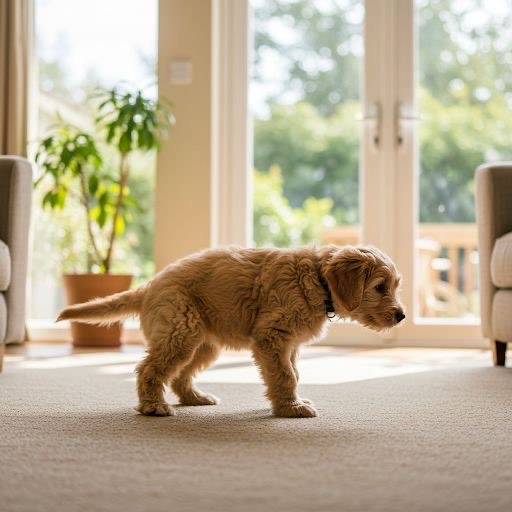
 PART I: Understanding your puppy's needs - or don't expect miracles from your little one

Potty training is not a sprint, it’s a process. And like any process, it requires understanding who (or rather what!) you’re dealing with. A puppy is not a miniature adult dog. It’s more like a baby on all fours: adorable, defenseless, and… completely unaware that it just peed on your new carpet.
1.1. Mini bladder, zero control

Puppies, especially in the first weeks of life (8-12 weeks), have a microscopic bladder and no control over its emptying. This is not malicious. It is physiological. Their bodies cannot yet "hold" urine - if they have to, they simply have to. And that's it.
 General rule: the puppy can "hold out" for a maximum of as many hours as it is months old + 1. So a 2 month old puppy: 2+1 = 3 hours no pee. It can – but it doesn't mean it has to, puppies often defecate after playing, drinking, eating, sleeping (even if the time we set hasn't passed)
And here's an important note: it's not his fault he can't cope - it's our responsibility to help him.
1.2. The brain needs time too
Dogs learn “where” to do their business, but they need consistency, repetition, and positive experiences to do it. A puppy’s brain can’t yet connect “pee = bad,” especially if a human is yelling or waving their hands. They react to emotions but don’t know what’s going on. So yelling = chaos = stress = more accidents.
The puppy is not “doing it to spite you”. He simply does not know what he is doing. Running towards him when he is already “doing his business” in order to quickly take him outside will do more harm than good. The puppy will simply be afraid of us and will avoid peeing in our presence. What is more, by behaving in this way we are sending him powerful threatening signals. We are simply running to “attack him – in his understanding” (pick him up off the floor and take him outside).
1.3. Development Stages – When and What to Expect
| Age | What can you expect? |
|---|---|
| 8–10 weeks | Zero control, complete dependence on humans |
| 11–14 weeks | The beginnings of associating a place with doing things |
| 15–20 weeks | Increasingly rare “failures”, more and more successes |
| 5–6 months | You should already have a cleaning routine. |
| >6 months | If there are still problems, you need to look for the cause |
Some dogs catch on faster, some slower – this is not a race. Comparing your dog to “your neighbor’s dog that was clean in a week” is a recipe for frustration and unnecessary tension.
1.4. Signals we ignore, but the dog is trying to tell us something
Puppies usually they give signsthat they want to relieve themselves – only we don’t read them.
Here are some common behaviors that mean, “Hello, I have to pee!”:
- sudden interruption of play and spinning in place,
- intense sniffing of the floor,
- squeaking,
- walking in circles, looking for a corner,
- nervous behavior after sleeping or eating.
If you learn read these signals, you gain a huge advantage. This isn't fortune telling - this is basic communication.

PART II: Rituals and routines – the basis of success
Let's be clear: if there is no routine, there is no cleanliness. Puppies love repetition - it makes them feel safe and helps them learn faster. We, humans, often want to "eyeball" and "feel". And that is exactly daily schedule saves our carpets and nerves.
2.1. The Golden Rule: pee always after…
…so what? After EVERYTHING. Seriously. A puppy is a walking bladder on legs, so:
| Action | What are we doing? |
|---|---|
| Waking up (morning or nap) | Straight outside |
| Food | 5–15 min later walk |
| Intense fun | A walk right after |
| The caregiver returns home | Go for a walk right away |
| Before going to sleep | A short "pee walk" |
 Pro tip: even if the dog did his business an hour ago but just woke up – let's go!
2.2. Cleanliness Journal – Sounds Funny? But It Works!
You don't have to write a novel. Just a simple notebook or app on your phone where you write down:
-
feeding hours,
-
hours of dealing with things (successful and unsuccessful),
-
where did it happen,
-
what the dog was doing before.
You will see after a few days diagrams – and when you see them, you can predict them. And react before it's too late.
2.3. Fixed feeding times = predictable bowel movements
 Example schedule for a 10 week old puppy:
| Time | What's going on |
|---|---|
| 7:00 | Wake up, pee, walk |
| 7:15 | Breakfast |
| 7:30 | Walk (poop) |
| 10:00 | Nap → pee |
| 12:00 | Dinner + walk |
| 15:00 | Nap → pee |
| 17:00 | Dinner + walk |
| 19:00 | A toy, a quiet walk |
| 21:00 | Last pee before bed |
| 0:00 | Night pee (if necessary because owners go to bed late) |
Yes, it's a lot. But thanks to this, after 2-4 weeks you will have a clean dog. And then it's all downhill from there.
2.4. "Too late" is our fault, not the dog's
If your puppy peed in the middle of the living room, it means:
-
no one noticed the signal,
-
he didn't go out for too long,
-
he got too emotional and couldn't cope.
That is? He didn't fail. We did.
This is not a reason to flagellate yourself – just to improve the system. Sometimes it is enough to:
-
one more exit per day,
-
faster reaction after waking up,
-
space limitation (this will be discussed in the following parts).
2.5. Frequency of outputs – how often is “often enough”?
It depends on the age. The younger the dog, the more going out.
| Puppy age | Number of exits per day |
|---|---|
| 8–10 weeks | 10–12 times (yes, seriously) |
| 11–14 weeks | 8–10 times |
| 15–20 weeks | 6–8 times |
| 5–6 months | 4–6 times |
IMPORTANT: all "pee" trips count, even the 2-minute ones. It's not about the long walk - it's about the goal: to settle down and come back. But be careful not to go back immediately after peeing, you need to wait a minute or two so that the puppy does not associate the peeing with returning home. Otherwise, the effect will be the opposite - the puppy will not pee outside in order to explore - he will pee immediately after returning home.

PART III: Home support and good habits – or cleanliness from floor to ceiling
 PART III: Home support and good habits – or cleanliness from floor to ceiling
In this part, we break down what happens at home – because even the best daily schedule won’t help if the dog doesn’t know what to do. Where it can be arranged, When we reward him and Why the carpet smells like a public toilet at the train station.
3.1. A designated place to relieve yourself – your secret weapon
Your puppy needs to know where to go. Location chaos = more accidents. The location should be:
-
always the same,
-
easily accessible,
-
calm (no distractions),
-
with natural ground (grass, gravel, earth – if outdoors).
If you teach "outdoors", don't change your route or location every week. Routine saves everything.
If you teach "on the mat", also set one specific place in the house - do not move the mat around like a piece of decoration.
3.2. Rewarding – or the sacred moment “after”
Is your puppy doing business where he should? We celebrate. But with our heads.
 Reward:
-
right away after the activity is completed (not 10 seconds later!),
-
outside, not after returning home (because you will reward "coming back", not "pee"),
-
something attractive (a mini treat, enthusiastic praise – as if he had just won an Oscar for best pee).
 Don't do:
-
a big show in progress – he can stop and finish… in the living room,
-
rewarding “for nothing” – the dog learns the sequence: I do my business HERE → I get THIS.
3.3. What about the mats? Help or trap?
A controversial topic – so without beating around the bush:
A mat can be helpful, but only if:
-
you know that you won't make it outside with your dog (e.g. 4th floor apartment, winter, rain, stairs, no elevator),
-
the dog is very young and is just learning control,
-
you have a work schedule that sometimes overwhelms you.
But the mat can also get in the way if:
-
you treat it as a long-term solution (not a temporary one),
-
the dog also relieves himself outside of it - because it smells "allowed here".
-
you are allergic to proteins contained in urine
If you teach on a mat, treat it as a transitional stage. And gradually move it towards the door, and then - eliminate it completely.
3.4. What about a kennel, pen, and space constraints?
This isn't a prison. This is your secret weapon. Dogs naturally don’t like to make a mess where they sleep – so if you provide your puppy with a small, cozy space:
-
it will be easier for him to "hold on" and wait for the exit,
-
learning cleanliness will be faster,
-
accidents will be less frequent – and easier to manage.
 A kennel cage (appropriately selected!) or a fenced pen is educational space, not punishment.
Limited space = more control = fewer accidents = peace of mind for the caregiver.
3.5. Cleaning up after a "blunder" - it's not just about cleanliness, but also about... the smell
It's not just aesthetics. It's behavioral science. A dog is guided by its nose, so if you don't neutralize the smell:
-
will come back to this place like a boomerang,
-
will think that "it's possible here".
 What to clean with?
-
Enzymatic agents – break down odorous compounds (e.g. dedicated products for animals).
-
Avoid chlorine, lemon, vinegar – they mask the smell for you, not the dog.
 It's worth having at the ready:
-
paper towels,
-
enzyme spray,
-
barriers (to limit access to "favourite places for accidents").

PART IV: The Most Common Mistakes and How NOT to Make Them

If you’ve ever grabbed your head and exclaimed, “Why did he do it on the carpet again?!” then… welcome to the club. Below is a list of common mistakes that even experienced caregivers can make. But don’t worry – every single one of them can be fixed. Or better yet – simply avoid them.
4.1. Too much freedom = too many opportunities for mistakes

A puppy left to its own devices = a puppy that will “do its thing somewhere.” Because it can, because no one is looking, because the carpet looks like grass.
Mistake: "Let him walk around the house, let him get used to it."
We change it to: "Until he understands his physiological needs, his space is limited: a cage, a playpen, one room, with your supervision."
 The principle is simple: you don't see the dog = you can expect a surprise.
4.2. Punishment "after the fact"
It’s a classic, unfortunately. You find a puddle, call your dog, show him the “evidence of a crime” and say “yuck,” “bad dog,” or worse yet — take him to the puddle so he “knows why.”
Mistake: the dog does NOT connect the dots in time. He thinks: "Why does the human get mad when I approach him?" Next time I'll pee somewhere hidden, preferably on the bed - maybe he won't notice.
We change it to: We ignore the mistake, we clean without a word, we draw conclusions (why didn't we make it in time?) and next time we are faster.
A dog learns by association, not by remorse.
4.3. For rarely going out
In fact, most of the "dirty" problems are not the dog, but too few walks.
“But he was there an hour ago!” — yes, but since then:
-
ate,
-
drank water,
-
he played with the children,
-
was petted by a neighbor…
And all this = emotions + full bladder.
Mistake: assuming that the dog “should endure.”
We change it to: prevention. We are leaving before must — not after the fact.
4.4. Too late reward
If you only reward your dog when you get home, guess what happens? Yep — your dog will rush back to get his reward. And he’ll pee in the hallway or not at all.
Mistake: "Bravo! Good thing you peed! (5 minutes after the fact)"
We change it to: prize at the moment end of the activity, preferably immediately after peeing/pooping — still outside. And even better, add a command to this - the dog starts peeing, we say "PEEE". You will not even notice how the puppy will relieve itself on command.
It doesn't have to be a feast of the gods - just one favorite tidbit + a voice full of pride will suffice.
4.5. Unreadable message "what he did well"
We often praise a dog when it comes back from a walk. But we don't say why. Or we praise so generally that the dog doesn't even know what it did.
Mistake: reward “for a walk”, not “for doing business outside”.
We change it to: clear scheme. You wait for it to get sorted out, immediately after you praise (e.g. "good pee!"), give a treat, and only then go home.
 Bonus: you can introduce a command ("pee", "poop") - after a while, the dog will associate it with relieving itself. Mega useful when traveling or when you need to quickly leave.
4.6. Over-reliance on sanitary mats
We've already mentioned this, but let's repeat it: the mat is a temporary aid, not a way of life.
Mistake: leaving the mat endlessly "because it will still happen sometimes".
We change it to: a plan to phase out the mat. Gradually limit its availability, moving it towards the door, until finally – it disappears from the dog's life.
4.7. Lack of consistency between household members
You train the dog outside, but your husband sometimes lets him use the mat. The kids don't notice the dog fidgeting nervously, and Grandma feeds him at 10 p.m.
Mistake: everyone does it their own way.
We change it to: one plan for all. Written, simple, with rules that everyone sticks to.
Because the dog has no chance of understanding the rules, which change depending on who is standing with him at the door.

PART V: Maintaining the effects and living without surprises
 PART V: Maintaining the effects and living without surprises
In this part we will focus on, what to do to maintain good habits, not to accidentally ruin them and how to deal with situations that can throw your dog off track (and you off balance). Because, as we know, life can be unpredictable. But you are ready for that.
5.1. When can you say that a dog is “trained”?
This is a common question. The answer? When:
for at least 2-3 weeks there was not a single "slip-up",
the dog itself communicates the need to go out (e.g. approaches the door, squeaks, fidgets nervously),
defecates regularly during walks, not after returning home,
you can leave it for a few hours without stress and come back to a clean floor.
This does not mean that it is already forever you have the cleanliness issue out of your head, but you are in a place where you can move from learning mode to consolidation mode.
5.2. Changing weather, new places, travels – how not to go back to square one
It happens: the dog mastered everything beautifully at home, but then:
-
it's raining → "I won't go out. It's cold."
-
you're visiting friends → "Oh, new carpet!"
-
hotel, new apartment, new scents → “Where’s my toilet?!”
 Don't panic. This is not a flashback, it's just normal reaction to a change in environment.
In new places:
-
keep your dog on a leash and show me where to relieve myself,
-
reward the first success in a new place - it's like saying "the old rules apply here too",
-
for the first days watch him as if he were just starting to learn – prevention is better than cure.
5.3. Changes in the daily rhythm – and how not to screw them up
Vacation, job change, renovation, guests, new dog, baby… life can turn your schedule upside down. And dogs are creatures of routine – any change can affect their behavior.
Principle: every change = we go back to the basics for a moment.
 You don't have to start from scratch, but:
-
increase the frequency of walks,
-
remember the warning signals,
-
Reward as if it were day 1.
It works – and it reassures your dog that you are still a team.
5.4. Regression? Don't be dramatic. Take action.
Sometimes – out of the blue – the dog does something in the house again. Maybe once, maybe twice. What then?
The worst thing you can do? Get angry and say that "it's all in vain."
The best thing you can do? Identify the cause:
-
Has the dog been alone for too long?
-
Has anything changed in his diet?
-
Did he experience something stressful?
-
Has anything changed in your routine?
Treat this as a signal: "hello, something is wrong" - and return to standby mode for a while.
5.5. What about adult dogs that have regressed?
It's not just puppies who have problems with cleanliness. Adult dogs who:
-
have experienced trauma,
-
were in a shelter,
-
they had a change of home,
-
were sick, they may forget that "you don't pee in the house".
 In an adult dog the procedure is similar:
-
Limited space.
-
Frequent outings.
-
Rewarding for success.
-
Zero penalties.
-
Observation + routine.
The good news is that an adult dog often learns faster – because he can control his bladder for longer and makes connections faster.
5.6. Cleanliness is a process, not a straight line
Remember – learning cleanliness is not a series of successes, but a process with peaks and valleys. It is important that:
-
stick to routine,
-
do not react emotionally to failures,
-
appreciate progress,
-
be patient (yes, that word again).
And most importantly - keep your distance. Because in a few months you'll be telling people how your puppy used to pee on the curtains and now only on the grass. And you'll be as proud of him as a peacock.

PART VI: Your role, patience and mindset – or how not to go crazy and not throw the dog bed out the window

6.1. Understanding the Dog's Perspective
Let's start with empathy. Your puppy is not being mean. He is not trying to make you mad. He doesn't know that a carpet is not a toilet, until you teach him.
It's like you were suddenly going to live in Japan and from day one someone expected you to know all the rules of the culture. No translation. Well, it doesn't work.
The dog needs time to associate the facts:
-
place + moment + physiological need = success + reward.
It doesn't read your mind. It doesn't understand the line "how many times do I have to tell you?!" It learns on the basis associations and repetitions. And you are his teacher.
6.2. Mindset: "it will pass" - because seriously, it will pass
Puppyhood is a phase. Intense, sometimes messy, but temporary. Every dog that doesn't pee in the house today did it at some point.
Even if:
-
you are standing barefoot in surprise,
-
you clean for the third time that day,
-
and you feel like it will never end…
THIS WILL HAPPEN.
And even faster than you think, if you don't give up. Sometimes a few weeks of a good system are enough and you have peace of mind for years.
6.3. Patience is not a gift - it's a choice
It's not that some people have "more patience". They just they choose not to get emotional. You can too.
Instead:
-
get angry,
-
throwing around the words "he'll never learn",
-
search forums in panic,
You can:
-
take a deep breath (and a long exhale),
-
remember the plan,
-
get back to basics and just move on.
Pro tip: Write down your successes. Even the small ones. “There were no mishaps today!” – it’s worth seeing that on paper when your faith in humanity weakens.
6.4. Mistakes are part of the process – not a reason for drama
There is no perfect system. Even if you have a chart, an alarm every 2 hours and a dog on GPS – accidents happen.
But you know what? These are information moments. They tell you, "Something didn't work here. Check what it was." And that's great.
Because thanks to this:
-
you improve your strategy,
-
you are learning a dog,
-
and ultimately you become an increasingly better duo.
 The worst thing you can do? Get pissed off and give up.
 The best thing? Accept that this is part of the journey – and move on.
6.5. Take care of yourself (seriously)
It sounds cliché, but… tired man = angry man = man who yells at dog for something the dog doesn't understand.
So:
-
sleep when the puppy sleeps (just like with a baby),
-
eat properly, not just a candy bar between walks,
-
ask for help – partner, children, neighbor. You don't have to be a solo hero.
Because you know what? If you are calm and balanced – the dog learns faster too. Dogs read us like an open book. And you can't teach a puppy to be clean from a level of frustration.
6.6. Don't compare your puppy with others
"And my friend's sister had a dog that was clean from the age of 8 weeks."
"And in a Facebook group someone wrote that his labradoodle would open the door and pee in the toilet by itself..."
STOP.
Every dog is different. Every human is different. This is not a race. Your dog is not a benchmark, but a separate entity with its own pace.
Your dog doesn't need pressure. He needs you. presence, peace and consistency.

Good luck! You can do it!!
The author of the text is Edyta Gajewska. Copying, processing, distribution of these materials in whole or in part without the author's consent is prohibited.


